Every living cell depends on a steady flow of nutrients, gases, and waste products. This flow happens through a thin, flexible barrier called the cell membrane. Transport through cell membrane is the process that allows substances to enter or leave a cell while keeping its internal environment stable.
Without this process, cells could not absorb oxygen, release carbon dioxide, or remove toxins. Therefore, understanding how molecules cross the membrane helps explain how the human body functions at its most basic level. Dental and medical students often study this topic early because it forms the foundation of cell physiology, tissue health, and even oral biology.
In this article, we will explore the basic mechanism of transport, followed by a closer look at active transport and passive transport. We will also include a comparison table and a simple flowchart to make these concepts easier to remember. By the end, you will understand why transport through cell membrane matters for every system in the body.
Basic Mechanism of Transport
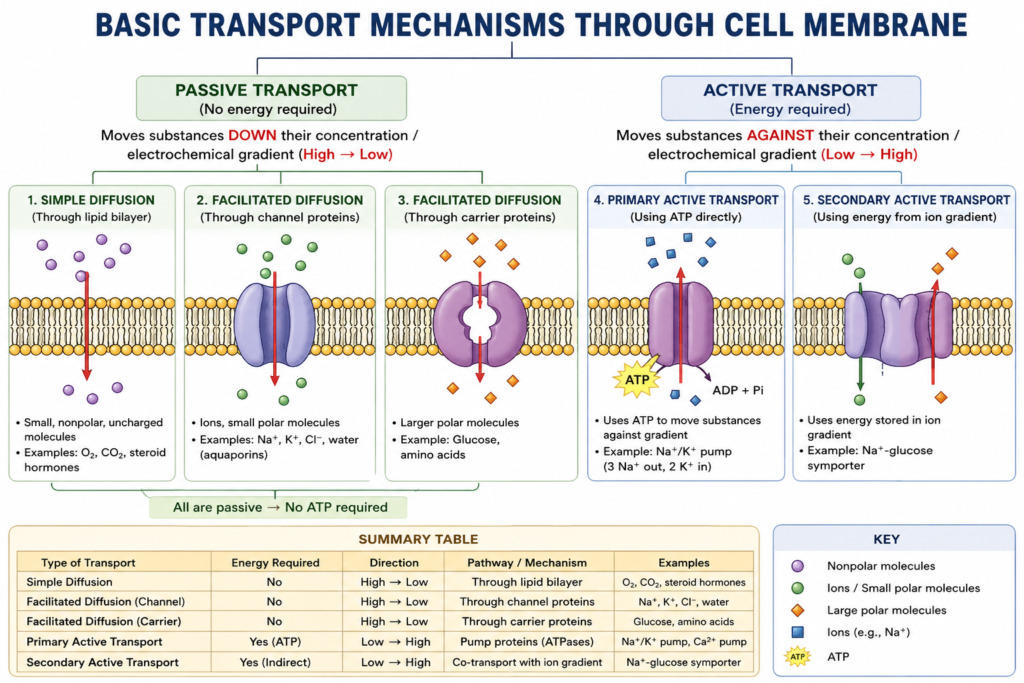
The cell membrane is made of a lipid bilayer with embedded proteins. This structure controls what enters and exits the cell. Some molecules pass freely, while others need help from specific protein channels or carriers.
Generally, three factors decide how a substance crosses the membrane:
- Size of the molecule – Small molecules slip through more easily than large ones.
- Polarity – Non-polar molecules pass through the lipid layer directly. Polar molecules usually need a protein channel.
- Concentration gradient – Substances often move from an area of high concentration to low concentration.
As a result, the membrane acts like a smart gatekeeper. It allows useful substances in, keeps harmful ones out, and removes waste efficiently. Additionally, this selective behavior is called “selective permeability,” a defining feature of all living cells.
Transport mechanisms generally fall into two broad categories: passive transport and active transport. The key difference lies in energy use. Passive transport does not require cellular energy, while active transport depends on ATP. Consequently, these two systems work together to maintain balance, a process known as homeostasis.
Below is a simple flowchart showing how the cell decides which transport method to use.
Flowchart: Choosing a Transport Pathway
            Substance Approaches Cell Membrane
                          |
                          v
        Is the molecule small and non-polar?
            /                          \
          YES                           NO
           |                             |
           v                             v
   Passes directly through      Needs a protein channel
   the lipid bilayer            or carrier protein
   (Simple Diffusion)                    |
                                          v
                          Is the movement with the gradient?
                              /                        \
                            YES                          NO
                             |                            |
                             v                            v
                     Passive Transport              Active Transport
                  (No energy required)         (Requires ATP energy)
This flowchart highlights how the cell automatically chooses the most efficient route. Meanwhile, the body relies on both pathways every second to stay alive and functional.
Passive Transport
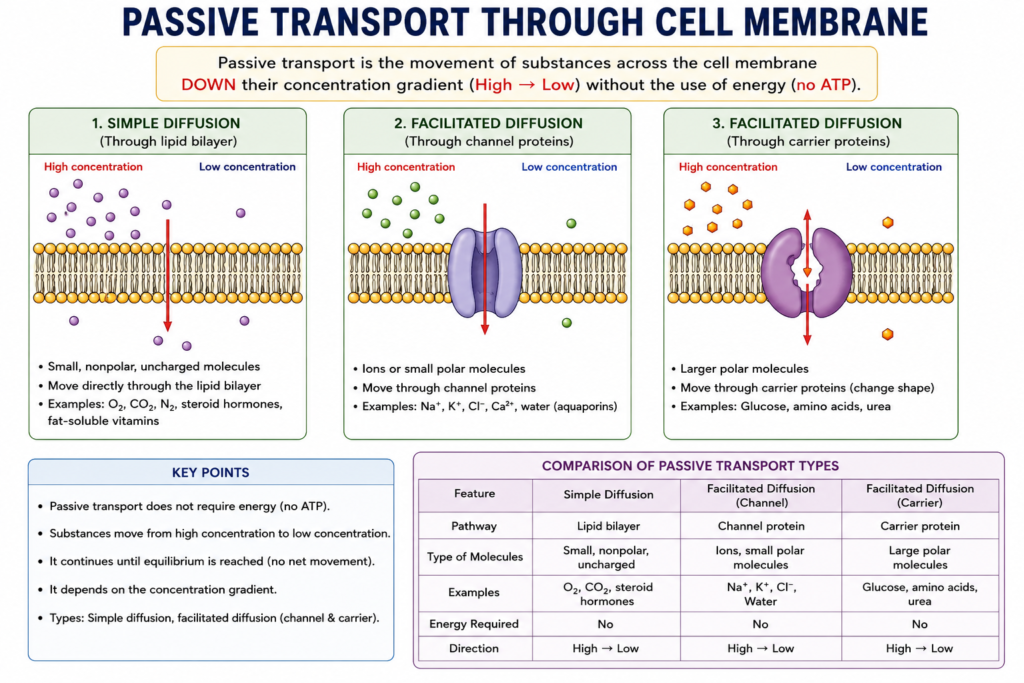
Passive transport moves substances without using cellular energy. Instead, it relies on the natural movement of molecules from high to low concentration. This movement continues until the concentration becomes equal on both sides of the membrane.
There are several types of passive transport:
- Simple Diffusion – Small, non-polar molecules like oxygen and carbon dioxide pass directly through the membrane.
- Facilitated Diffusion – Larger or polar molecules, such as glucose, move through specific protein channels.
- Osmosis – Water moves across the membrane toward the side with higher solute concentration.
- Filtration – Pressure pushes water and small solutes through the membrane, commonly seen in kidney function.
For example, when oxygen enters red blood cells, it moves through simple diffusion because the lungs contain more oxygen than the blood. Similarly, glucose enters cells through facilitated diffusion since it cannot cross the lipid layer alone.
Passive transport is efficient because it does not drain the cell’s energy reserves. However, it only works as long as a concentration gradient exists. Once the gradient disappears, the movement stops. This is one major distinction between passive and active processes.
In dental physiology, passive transport explains how nutrients and oxygen reach the cells within tooth pulp and gum tissue. Blood vessels deliver oxygen, and it diffuses passively into surrounding cells to support healing and repair.
Active Transport
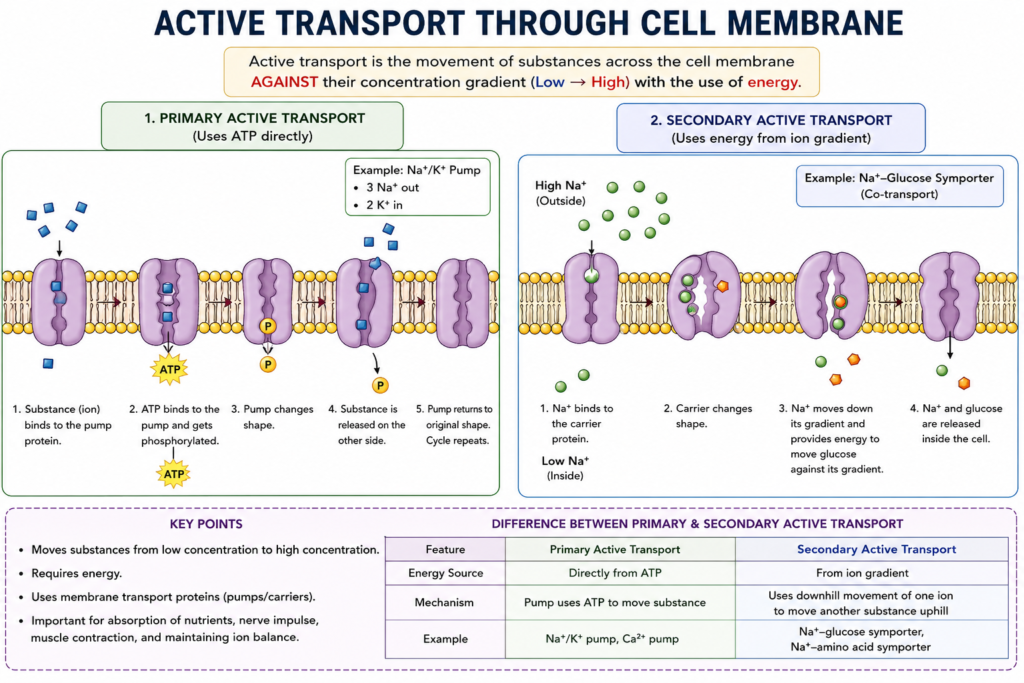
Active transport moves substances against their concentration gradient, meaning from low to high concentration. Since this goes against the natural flow, the cell must use energy in the form of ATP.
There are two major types of active transport:
- Primary Active Transport – Uses ATP directly to move molecules. The sodium-potassium pump is a classic example, maintaining proper nerve and muscle function.
- Secondary Active Transport – Uses the energy stored in an existing gradient to move another substance. This process is also called co-transport.
For instance, the sodium-potassium pump pushes sodium ions out of the cell and potassium ions in, even though both move against their gradients. This pump plays a vital role in nerve signaling, muscle contraction, and even saliva production in the oral cavity.
Active transport is essential because many nutrients and ions must accumulate inside cells at higher concentrations than outside. Without it, the body could not absorb certain vitamins, minerals, or amino acids effectively. Furthermore, active transport supports vesicular transport methods like endocytosis and exocytosis, which move larger particles across the membrane.
This form of transport through cell membrane requires continuous energy supply. Therefore, cells with high metabolic activity, such as kidney and intestinal cells, contain large numbers of mitochondria to meet this demand.
Active vs Passive Transport: Quick Comparison
| Feature | Passive Transport | Active Transport |
|---|---|---|
| Energy required | No | Yes (ATP) |
| Direction of movement | High to low concentration | Low to high concentration |
| Examples | Diffusion, osmosis, filtration | Sodium-potassium pump, endocytosis |
| Speed | Depends on gradient strength | Controlled by cell energy levels |
| Stops when | Gradient is equalized | Energy supply runs out |
This table makes it easy to compare both mechanisms side by side. Overall, both systems complement each other to maintain cellular balance and proper organ function.
Conclusion
Transport through cell membrane is one of the most important processes in human physiology. It allows cells to absorb nutrients, release waste, and maintain a stable internal environment. Passive transport handles simple, energy-free movement, while active transport manages the more demanding job of moving substances against their natural gradient.
Together, these mechanisms keep tissues healthy, support nerve function, and even influence oral health through proper nutrient delivery to gums and teeth. Understanding these basic principles gives a clearer picture of how the body works at the cellular level. In short, healthy cells depend on efficient, well-balanced transport systems every single day.
Frequently Asked Questions
It is the movement of substances like ions, nutrients, and gases across the cell membrane, either with or without the use of energy.
Active transport requires ATP and moves substances against their concentration gradient. Passive transport needs no energy and follows the natural concentration gradient.
It maintains proper ion balance inside and outside cells, supporting nerve impulses, muscle contractions, and normal cell function.
No. Osmosis is a passive process where water moves naturally toward areas with higher solute concentration.
Cellular transport supports nutrient delivery to gum and tooth tissue, helping with healing, repair, and overall oral health.