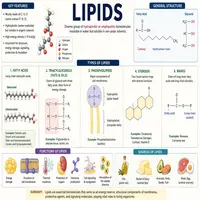
Lipids: Structure, Types, and Functions Understand Easily
Lipids are a diverse group of organic compounds that are insoluble in water but soluble in non-polar solvents such as chloroform and ether. Although they are structurally varied, all lipids share this defining hydrophobic character. Lipids serve as the body’s primary energy reserve, and they also form the structural backbone of every cell membrane. Because lipids influence everything from hormone synthesis to nutrient absorption, dental and medical students must understand their chemistry thoroughly before moving into clinical biochemistry.
Fatty Acids
Fatty acids are long hydrocarbon chains ending in a carboxylic acid group (–COOH). They form the basic building blocks of most lipids, including triglycerides and phospholipids. Consequently, understanding fatty acid structure is the first step toward understanding lipids as a whole.
General formula: CH₃–(CH₂)ₙ–COOH
| Type | Example | Molecular Formula | Double Bonds |
|---|---|---|---|
| Saturated | Stearic acid | C₁₈H₃₆O₂ | 0 |
| Monounsaturated | Oleic acid | C₁₈H₃₄O₂ | 1 |
| Polyunsaturated | Linoleic acid | C₁₈H₃₂O₂ | 2 |
Saturated fatty acids contain only single carbon-carbon bonds, so their chains pack tightly and remain solid at room temperature. Unsaturated fatty acids, on the other hand, contain one or more double bonds, which introduce kinks into the chain; as a result, they tend to be liquid at room temperature. Because of this structural difference, saturated and unsaturated lipids behave very differently in both food and the human body.
Essential Fatty Acids
Essential fatty acids are those the human body cannot synthesize on its own and must therefore obtain from the diet. Linoleic acid (omega-6) and alpha-linolenic acid (omega-3) are the two principal essential fatty acids. These lipids are precursors for eicosanoids, including prostaglandins and leukotrienes, which regulate inflammation, blood clotting, and immune responses.
Triglycerides (Triacylglycerols)
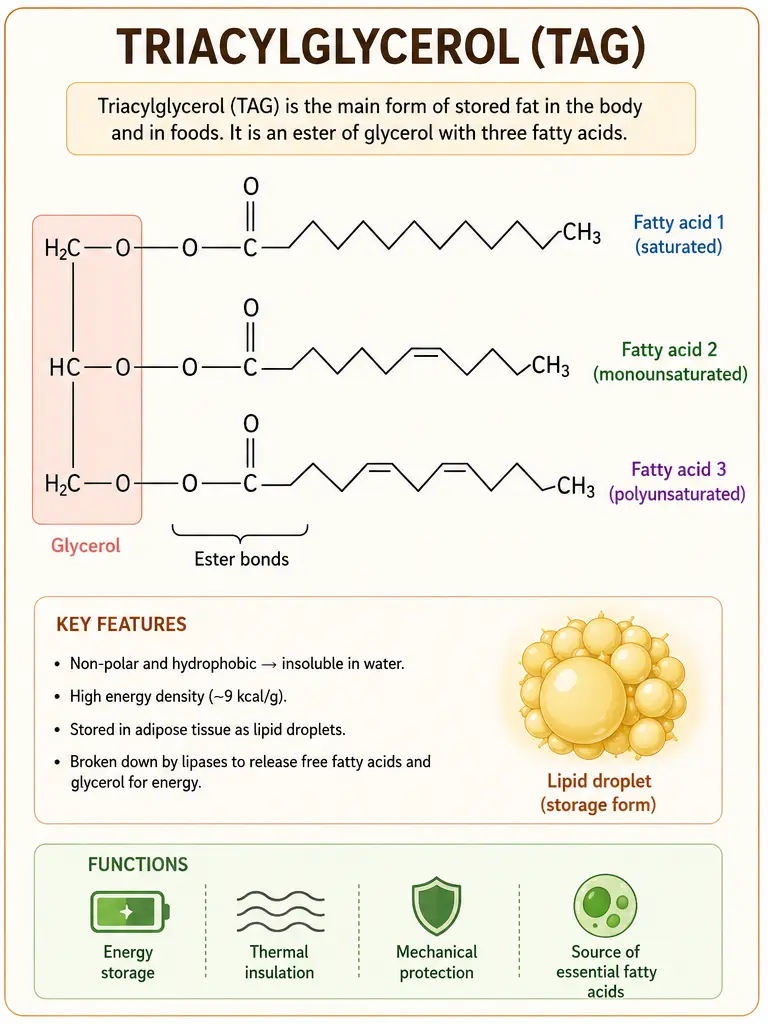
Triglycerides, also called triacylglycerols, are formed when three fatty acid chains are esterified to a glycerol backbone. But they represent the most concentrated form of stored energy in the body.
       CH2-O-CO-R1
       |
Glycerol  CH-O-CO-R2
       |
       CH2-O-CO-R3
Because triglycerides are non-polar, they are stored efficiently in adipose tissue without binding excess water. This makes them an extremely energy-dense fuel source — roughly 9 kcal per gram, compared to 4 kcal per gram for carbohydrates and proteins.
Phospholipids
But Phospholipids are structurally similar to triglycerides, except that one fatty acid chain is replaced by a phosphate-containing group. Thus, this substitution gives phospholipids a unique dual character: a hydrophilic (water-loving) phosphate head and two hydrophobic (water-fearing) fatty acid tails.
Structure: Glycerol + 2 fatty acids + phosphate group + polar head group
Because phospholipids are amphipathic, they spontaneously arrange themselves into bilayers in an aqueous environment. This self-assembling property is precisely why phospholipids form the basic structural framework of all cell membranes, including those of oral epithelial cells and salivary gland cells.
Glycolipids
Cerebrosides and gangliosides are two well-known examples. Glycolipids also play a role in determining blood group antigens and in mediating bacterial adhesion to mucosal surfaces — a process highly relevant to the colonization of oral bacteria on tooth and gum tissue.
Lipoproteins
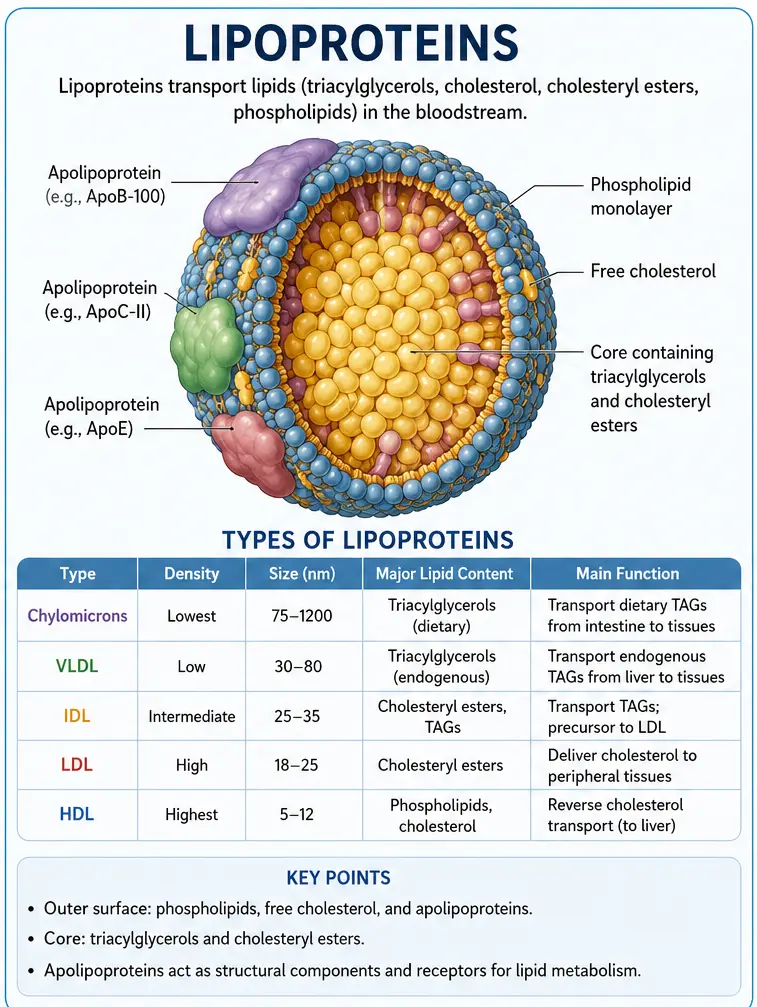
Since lipids are insoluble in plasma, they must be transported through the bloodstream packaged inside lipoproteins. Thus, these are spherical particles consisting of a lipid core surrounded by a shell of phospholipids, cholesterol, and specialized proteins called apolipoproteins.
| Lipoprotein | Density | Primary Function |
|---|---|---|
| Chylomicrons | Lowest | Transport dietary triglycerides from intestine |
| VLDL | Very low | Transport triglycerides from liver |
| LDL | Low | Deliver cholesterol to tissues (“bad” cholesterol) |
| HDL | High | Remove excess cholesterol (“good” cholesterol) |
Lipid Transport Flowchart
Dietary Fat → Intestine → Chylomicrons → Bloodstream → Tissues (energy use/storage)
                                              ↓
                                       Liver synthesizes VLDL
                                              ↓
                                       VLDL → LDL → Cells (cholesterol delivery)
                                              ↓
                                       HDL → Liver (cholesterol removal)
Steroids
Steroids form a distinct class of lipids built upon a four-ring carbon skeleton rather than long hydrocarbon chains. Cholesterol is the parent steroid molecule, with the molecular formula C₂₇H₄₆O, and it serves as the precursor for vitamin D, bile acids, and steroid hormones such as cortisol, estrogen, and testosterone. Cholesterol is also a vital structural component of cell membranes, where it modulates membrane fluidity.
Amphipathic Lipids
Amphipathic lipids contain both a polar (hydrophilic) region and a non-polar (hydrophobic) region within the same molecule. Phospholipids, glycolipids, cholesterol, and bile salts all fall under this category. Because of their dual nature, amphipathic lipids align at water-lipid interfaces, forming micelles, bilayers, or monolayers depending on their concentration and environment.
Amphipathic Lipid Behavior in Water
        Polar Head (water-loving)
              ●●●●●
              |||||
              |||||  ← Non-polar tail (water-fearing)
              |||||
   WATER  ▔▔▔▔●●●●●▔▔▔▔  WATER
              (Bilayer formation)
This amphipathic property is fundamental to digestion as well, since bile salts use the same principle to emulsify dietary fats within the small intestine.
Soaps and Detergents
Detergents are amphipathic lipid derivatives engineered specifically for cleansing purposes. Soaps are typically sodium or potassium salts of long-chain fatty acids, produced through a saponification reaction between fats and an alkali.
| Property | Soap | Detergent |
|---|---|---|
| Source | Natural fats/oils | Synthetic petrochemicals |
| Reaction | Saponification | Sulfonation |
| Hard water performance | Poor | Excellent |
| Common use | Hand and body wash | Oral rinses, toothpaste surfactants |
Conclusion
Lipids encompass an enormously varied family of molecules, ranging from simple fatty acids to complex lipoproteins and steroids. Despite their structural diversity, lipids consistently serve three core roles: energy storage, structural membrane formation, and signaling. For dental professionals, a solid grasp of lipid biochemistry is not merely academic; it directly informs the understanding of periodontal inflammation, oral mucosal cell biology, and even the formulation of everyday dental care products. As research continues to clarify the links between systemic lipid metabolism and oral health, this knowledge becomes increasingly indispensable in modern, evidence-based dental practice.