Enzymes Explained: How They Power Every Body Process
Every chemical reaction inside the human body needs help to happen quickly enough to support life. This help comes from enzymes. Enzymes are biological catalysts that speed up reactions without being used up in the process.
Without enzymes, digestion would take far too long, and cells would struggle to produce energy. Therefore, these tiny molecules play a massive role in keeping the body alive and functioning smoothly. From breaking down food to repairing tissue, enzymes touch nearly every system, including the mouth and digestive tract.
In this article, we will look at the basic structure of enzymes, the factors that influence their activity, and the major types found in the human body. We will also include a comparison table and a simple flowchart to make these ideas easier to follow. By the end, you will understand why enzymes deserve attention in both general health and dental care.
What Are Enzymes and How Do They Work
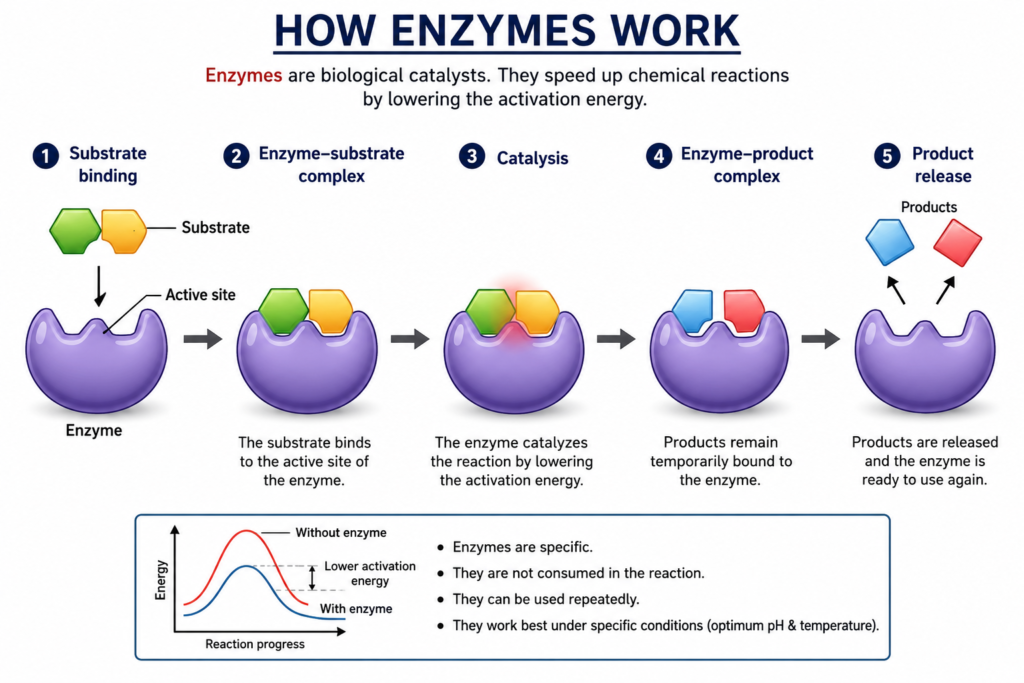
These are proteins made of long chains of amino acids folded into specific three-dimensional shapes. This shape creates a special pocket called the active site. The active site fits a particular molecule, known as the substrate, much like a key fits a lock.
Once the substrate binds to the active site, the enzyme lowers the energy needed to start the reaction. As a result, the reaction proceeds much faster than it would on its own. After the reaction finishes, the enzyme releases the product and remains unchanged, ready to repeat the process again.
This explains why even small amounts of an enzyme can manage thousands of reactions every second. Additionally, these are highly specific. Most enzymes only work with one substrate or a small group of similar molecules. For example, the enzyme amylase in saliva only breaks down starch, not proteins or fats.
This specificity keeps the body’s chemistry organized and efficient. Meanwhile, it has an optimal environment where it performs best, which leads directly to the next important topic.
Flowchart: How an Enzyme Reaction Happens
        Substrate Approaches Enzyme
                    |
                    v
     Substrate Binds to Active Site
                    |
                    v
   Enzyme Lowers Activation Energy Needed
                    |
                    v
        Chemical Reaction Takes Place
                    |
                    v
      Product Is Released from Enzyme
                    |
                    v
    Enzyme Becomes Free for Next Reaction
This cycle repeats continuously, allowing one these molecule to process many substrate molecules over time.
Factors That Affect Enzyme Activity
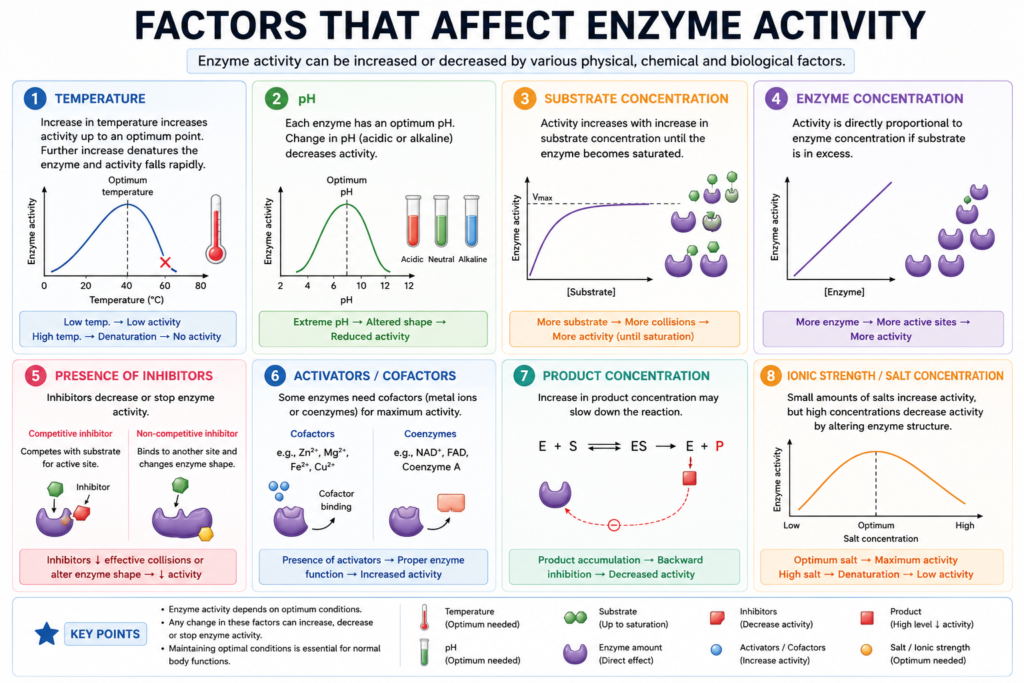
Several conditions influence how well an enzyme performs its job. Understanding these factors helps explain why these sometimes work efficiently and other times slow down or stop completely.
- Temperature – these work best within a narrow temperature range. Too much heat can destroy their shape, a process called denaturation.
- pH Level – Most enzymes prefer a specific pH range. For instance, pepsin works best in the acidic environment of the stomach, while salivary enzymes prefer a more neutral pH.
- Substrate Concentration – Higher substrate levels generally speed up the reaction until all active sites become occupied.
- Enzyme Concentration – More enzyme molecules allow more reactions to happen at the same time.
- Presence of Inhibitors – Certain molecules can block the active site or change the enzyme’s shape, slowing or stopping its function.
For example, extreme heat during a fever can disrupt their function throughout the body. Similarly, changes in oral pH from acidic foods or bacteria can affect enzymes involved in saliva and early digestion.
Consequently, the body works hard to maintain stable internal conditions, often called homeostasis, so enzymes can perform consistently. This balance is especially important in the mouth, where saliva enzymes begin the digestive process before food even reaches the stomach.
Types of Enzymes in the Human Body
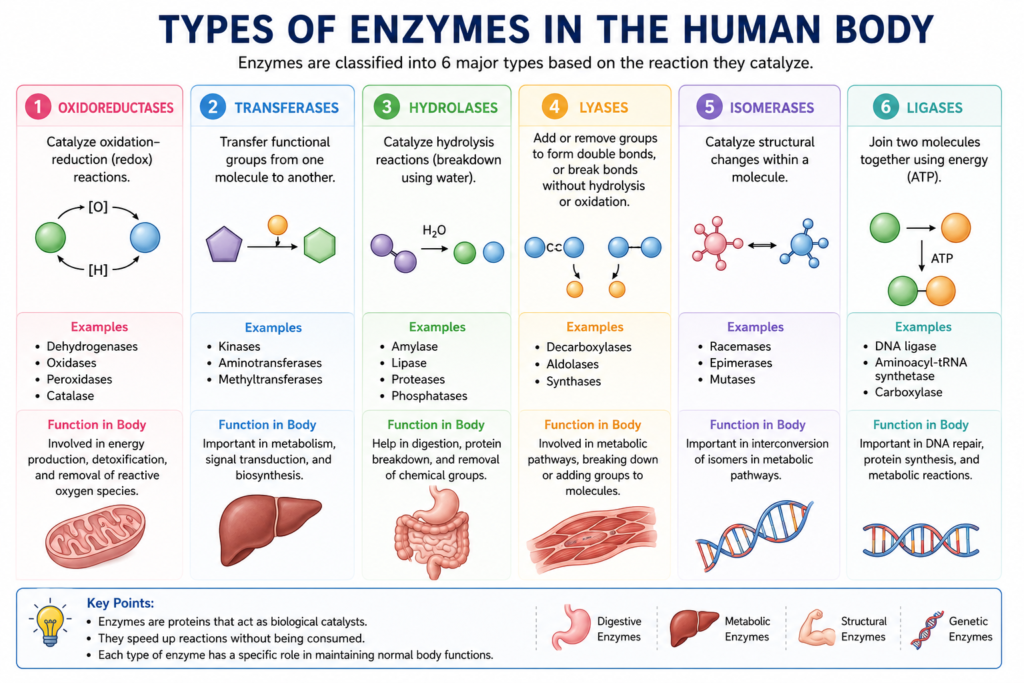
These exist in nearly every tissue and fluid in the body, including saliva, blood, and digestive juices. Generally, they are grouped based on the type of reaction they perform.
- Digestive Enzymes – Break down food into smaller, absorbable units. Examples include amylase, lipase, and protease.
- Metabolic Enzymes – Support energy production and cellular processes within tissues and organs.
- Hydrolases – Use water molecules to break chemical bonds, common in digestion.
- Oxidoreductases – Help transfer electrons during energy-producing reactions.
In the oral cavity specifically, salivary amylase begins carbohydrate digestion immediately after food enters the mouth. Furthermore, certain enzymes in saliva help protect teeth and gums by breaking down harmful bacterial byproducts. This connection makes these directly relevant to dental health, not just general physiology.
Overall, each of this type plays a unique role, yet they all share the same basic goal: speeding up essential chemical reactions safely and efficiently.
Quick Comparison Table: Enzyme Categories
| Enzyme Type | Main Function | Example | Location |
|---|---|---|---|
| Digestive | Breaks down food molecules | Amylase | Saliva, small intestine |
| Metabolic | Supports energy production | ATP synthase | Mitochondria |
| Hydrolase | Breaks bonds using water | Lipase | Pancreas, intestine |
| Oxidoreductase | Transfers electrons | Catalase | Liver, red blood cells |
This table offers a simple snapshot of how different enzymes contribute to overall body function.
Conclusion
Enzymes are essential biological tools that make life possible by speeding up chemical reactions throughout the body. They work through a precise lock-and-key mechanism, depend on stable conditions like temperature and pH, and come in many specialized forms suited to specific tasks.
From digestion to energy production, these influence nearly every system, including oral health through saliva-based digestion and bacterial defense. Understanding how enzymes function offers valuable insight into both general physiology and everyday dental care. In short, these small molecules carry an enormous responsibility in keeping the body balanced and healthy.
Frequently Asked Questions
These are proteins built from chains of amino acids folded into specific three-dimensional shapes.
High heat can break the bonds holding an enzyme’s shape together, causing denaturation and loss of function.
Digestive enzymes break large food molecules into smaller units that the body can easily absorb and use.
Salivary enzymes begin carbohydrate digestion and help break down harmful bacterial byproducts in the mouth.
Yes. Enzymes are not consumed during a reaction and can be used repeatedly to process many substrate molecules.