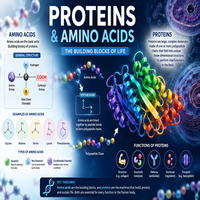
Protein and Amino Acid: A Complete Biochemistry Guide
Every living cell depends on protein for structure, movement, and chemical reactions. Behind every protein lies a chain of amino acid units, joined together in a precise order. Therefore, understanding amino acid chemistry helps explain how proteins fold, function, and interact within the body.
This guide explains amino acid structure, classification, and the bonds that link these units together. Additionally, it covers the four levels of protein structure and the biological roles that proteins perform. Tables and a flowchart simplify these concepts, so the article stays easy to follow for students and curious readers alike.
What Is an Amino Acid?
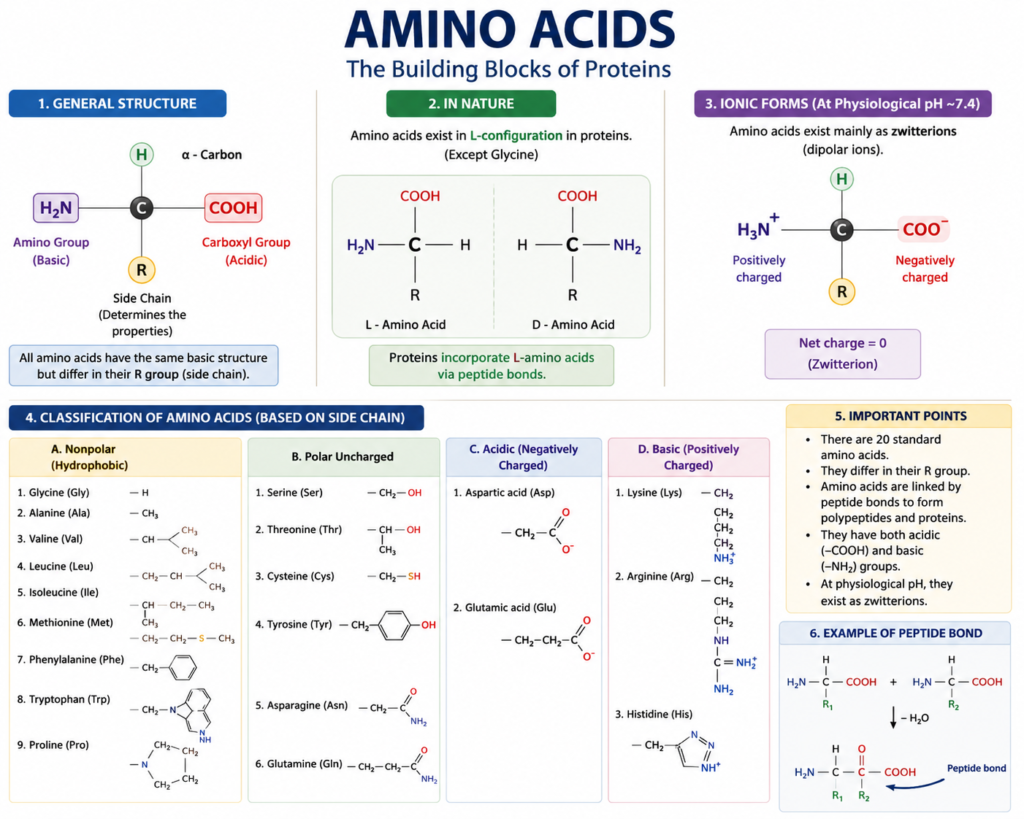
An amino acid forms the basic building block of every protein. It contains four parts attached to a central carbon atom: an amino group, a carboxyl group, a hydrogen atom, and a variable side chain. Consequently, the side chain determines the unique chemical behavior of each amino acid.
Twenty standard amino acids exist in nature, and cells combine them in different sequences to build countless proteins. Some amino acids carry a positive charge, while others remain neutral or negatively charged. As a result, these differences in charge and shape influence how a protein folds and behaves.
The body cannot produce all amino acids on its own. Hence, nutritionists divide them into essential and non-essential categories, as shown below.
| Category | Examples | Source |
|---|---|---|
| Essential | Leucine, lysine, valine | Must come from diet |
| Non-essential | Alanine, glutamine, serine | Body can synthesize |
| Conditionally essential | Arginine, cysteine | Needed during illness or stress |
Classification of Amino Acids
Biochemists classify amino acids by the chemical nature of their side chains. This classification helps predict how an amino acid will behave inside a protein structure. For instance, hydrophobic amino acids tend to hide inside the folded protein core.
Polar amino acids, on the other hand, often sit on the protein surface, where they interact with water. Meanwhile, acidic and basic amino acids carry charges that allow them to form ionic bonds with other charged groups. Similarly, these charged interactions stabilize the overall protein shape.
The table below organizes amino acids by their general side chain properties.
| Side Chain Type | Examples | Typical Location in Protein |
|---|---|---|
| Hydrophobic | Leucine, valine, phenylalanine | Protein core |
| Polar | Serine, threonine, asparagine | Protein surface |
| Acidic | Aspartate, glutamate | Surface, forms salt bridges |
| Basic | Lysine, arginine, histidine | Surface, forms salt bridges |
The Peptide Bond and Protein Formation
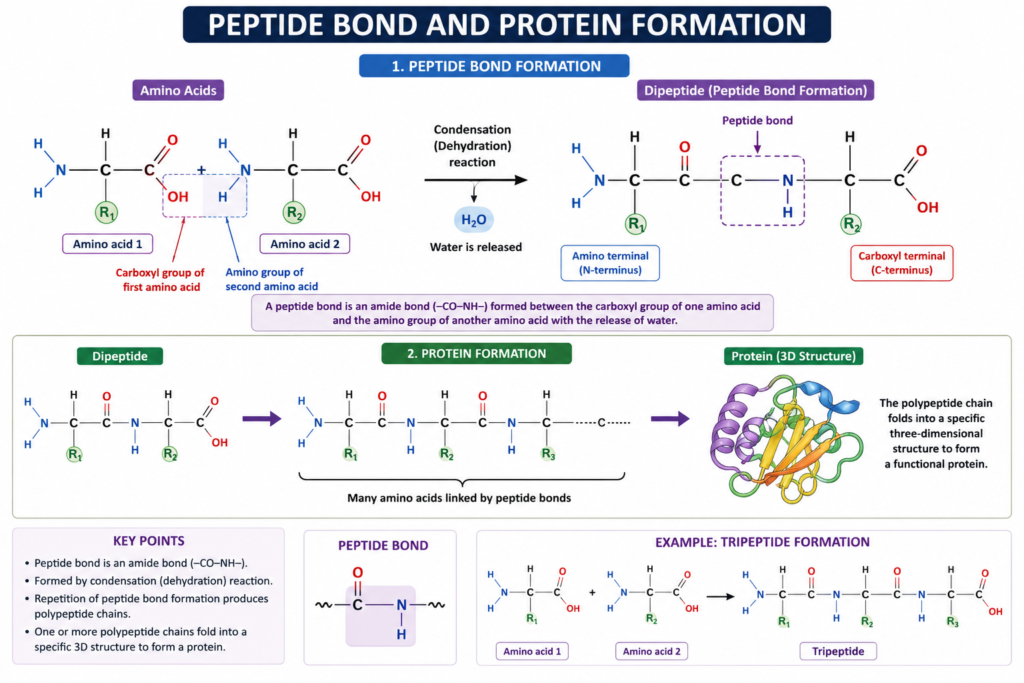
A peptide bond links one amino acid to another through a chemical reaction called dehydration synthesis. During this reaction, a water molecule leaves as the carboxyl group of one amino acid joins the amino group of the next. Subsequently, this process repeats many times to form a long chain.
This chain of linked amino acid units is called a polypeptide. Cells build polypeptides on ribosomes, following instructions copied from DNA through messenger RNA. Afterward, the polypeptide chain folds into a functional protein shape.
The flowchart below outlines this process in simple steps.
DNA Sequence
     |
     v
Messenger RNA (Transcription)
     |
     v
Amino Acid Chain (Translation)
     |
     v
Polypeptide Folding
     |
     v
Functional Protein
Because the sequence of amino acids determines the final shape, even a small change in this sequence can alter protein function. This sensitivity explains why genetic mutations sometimes cause disease.
Levels of Protein Structure
Proteins fold into four distinct structural levels, and each level builds upon the one before it. Biochemists study these levels to understand how a simple chain becomes a working molecule.
The primary structure refers to the exact sequence of amino acid units in the chain. Meanwhile, the secondary structure describes local folding patterns, such as alpha helices and beta sheets, held together by hydrogen bonds.
The tertiary structure represents the overall three-dimensional shape of a single polypeptide chain. In contrast, the quaternary structure applies only to proteins made of multiple polypeptide chains joined together. Hemoglobin, for example, displays quaternary structure because it contains four separate chains.
| Structure Level | Description | Bond Type Involved |
|---|---|---|
| Primary | Amino acid sequence | Peptide bonds |
| Secondary | Helices and sheets | Hydrogen bonds |
| Tertiary | 3D folded shape | Hydrophobic, ionic, disulfide bonds |
| Quaternary | Multiple chains together | Same as tertiary, between chains |
Functions of Protein in the Body
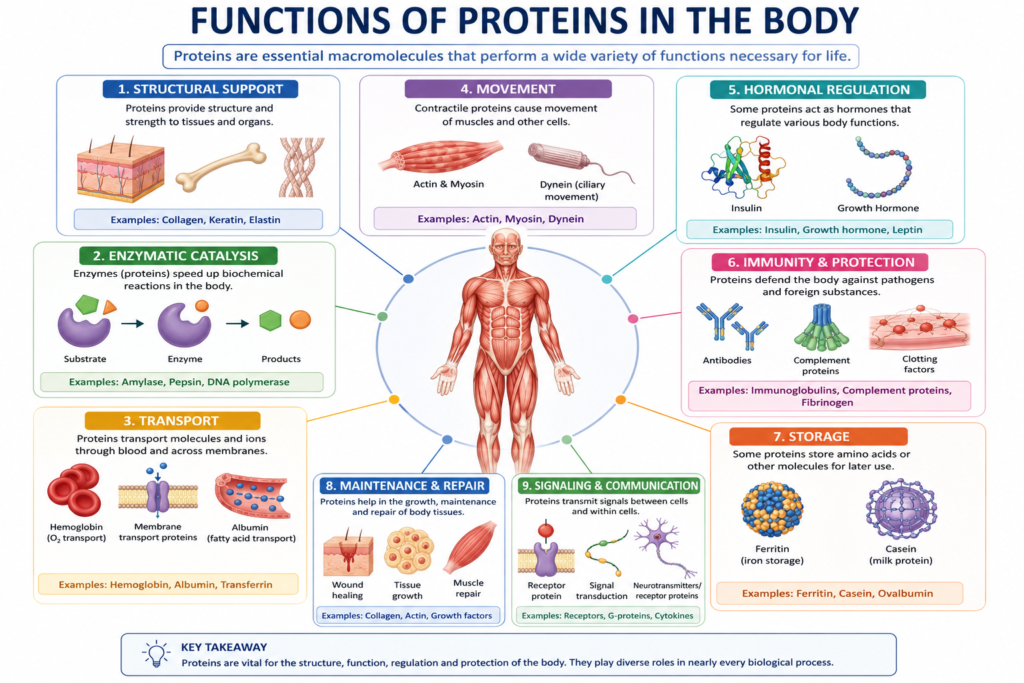
Protein performs countless roles within living organisms, far beyond simple structural support. Enzymes, for instance, are proteins that speed up chemical reactions inside cells. Without these catalysts, most biological reactions would proceed far too slowly to sustain life.
Other proteins act as transport molecules, carrying oxygen, nutrients, or signals throughout the body. Antibodies, which protect against infection, also consist of protein. Similarly, structural proteins like collagen and keratin provide strength to skin, bones, and connective tissue.
Hormonal proteins regulate processes such as growth and metabolism, while motor proteins enable muscle contraction and cell movement. Therefore, protein truly supports nearly every function within a living system, from digestion to immune defense.
Amino Acid Metabolism and Balance
The body constantly breaks down and rebuilds protein in a process called protein turnover. Old proteins get broken down into individual amino acid units, which the body can reuse to build new proteins. However, excess amino acids cannot be stored like fat or carbohydrate.
Instead, the liver converts excess amino acids into energy or stores them as glucose or fat. This conversion process removes the nitrogen-containing amino group, producing ammonia as a byproduct. Subsequently, the liver converts this ammonia into urea, which the kidneys then excrete.
Maintaining a balanced intake of amino acid sources supports muscle repair, immune function, and overall metabolic health. Athletes and growing children, for example, often require higher protein intake to support tissue repair and growth.
Conclusion
Protein and amino acid chemistry form the foundation of nearly every biological process. Amino acid units link together through peptide bonds to create polypeptide chains, which then fold into complex, functional proteins. From enzymes to structural fibers, protein supports growth, repair, and countless chemical reactions throughout the body. Understanding this chemistry, therefore, helps explain how nutrition, genetics, and metabolism connect within living systems.
Frequently Asked Questions
The amino acid serves as the basic unit of a protein. Chains of amino acid units link together to form polypeptides and proteins.
The human body requires nine essential amino acid types from food, since it cannot produce these on its own.
A peptide bond links amino acid units together, forming through a reaction that releases a water molecule.
The four levels include primary, secondary, tertiary, and quaternary structure, each describing a different aspect of protein folding.
The body needs protein to build enzymes, hormones, antibodies, and structural tissues, supporting growth, repair, and immune defense.