Every cell stores its genetic instructions in a special class of molecules. These molecules are nucleic acids and nucleotides. So,They carry the code for life. They also direct protein synthesis. In dentistry, understanding this biochemistry helps explain tissue growth, repair, and disease. moreover,This article breaks down nucleotides, DNA structure, DNA organization, and RNA structure in simple terms.
What Are Nucleotides?
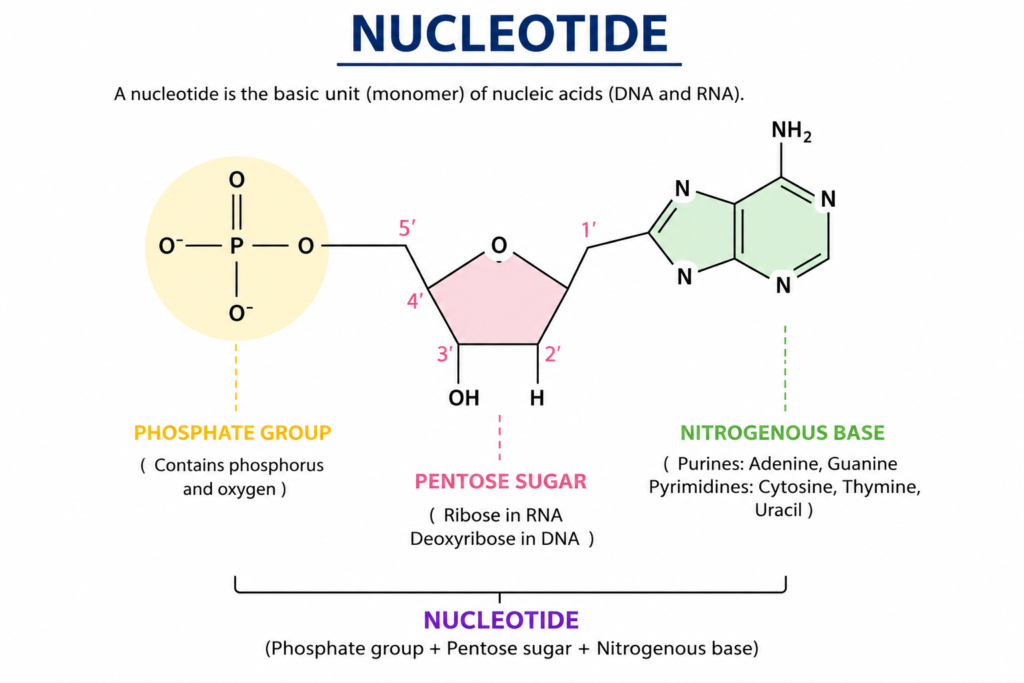
Nucleotides are the building blocks of nucleic acids. Each nucleotide has three parts. First, there is a nitrogenous base. Second, there is a five-carbon sugar. Third, there is a phosphate group. Together, these three parts link to form one unit. Many units then join to form long chains.
Moreover,nitrogenous bases fall into two groups. Purines include adenine and guanine.Mostly Pyrimidines include cytosine, thymine, and uracil. However, thymine appears only in DNA. Uracil, meanwhile, appears only in RNA. Thus,This small difference matters a lot during cell processes.
The table below shows the basic components of a nucleotide.
| Component | Description | Examples |
|---|---|---|
| Nitrogenous Base | Carries genetic code | Adenine, Guanine, Cytosine, Thymine, Uracil |
| Pentose Sugar | Forms backbone structure | Deoxyribose (DNA), Ribose (RNA) |
| Phosphate Group | Links nucleotides together | Phosphate ion |
Therefore, nucleotides act as the alphabet of genetic language. Without them, no genetic code could exist.
Structure of DNA
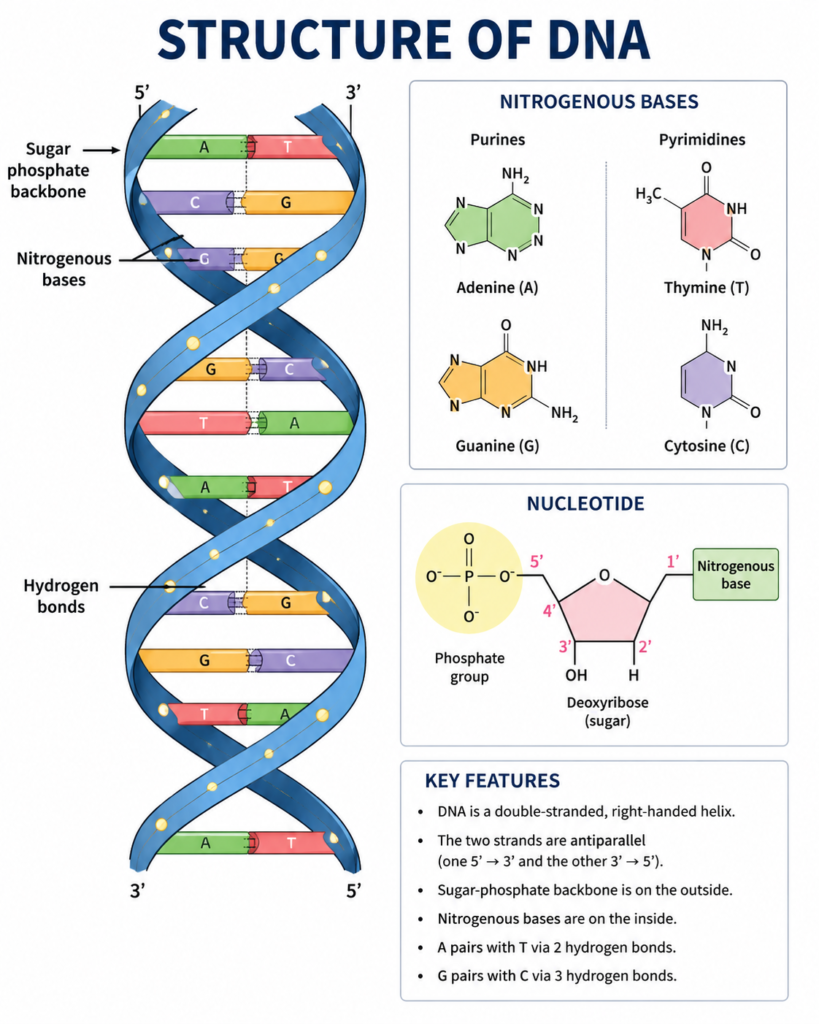
DNA stands for deoxyribonucleic acid.Moreover, It stores genetic information in nearly every cell. Structurally, DNA forms a double helix. Two strands twist around each other. Consequently, the molecule looks like a spiral staircase.
Each strand has a sugar-phosphate backbone. But,Bases attach to this backbone on the inside. Importantly, bases pair in a specific way.Furthermore, Adenine pairs with thymine.but, Guanine pairs with cytosine.Additionally, This pairing rule is called complementary base pairing. As a result, the two strands stay perfectly matched.
Thus,Hydrogen bonds hold the base pairs together. But,Two bonds form between adenine and thymine. Three bonds form between guanine and cytosine. Thus, guanine-cytosine pairs create slightly stronger bonds. But,This strength affects DNA stability in different regions.
Use up and down arrow keys to resize the meta box pane.Move upMove downToggle panel: Yoast SEO
Analysis resultsLearn more about the readability analysis(Opens in a new browser tab)
DNA Structure Flowchart
        NUCLEOTIDES
             |
   Sugar + Phosphate + Base
             |
     Strand Formation
             |
   Two Strands Twist Together
             |
       DOUBLE HELIX (DNA)
Overall, this elegant structure protects genetic information.But, It also allows accurate copying during cell division.
Organization of DNA in the Cell
DNA does not float freely inside the nucleus. Instead, it wraps tightly around proteins called histones. This wrapping creates a structure called a nucleosome.Furthermore, Many nucleosomes then link together like beads on a string.
Next, this chain coils further. It forms a thicker fiber called chromatinBut,. During cell division, chromatin condenses even more. But,At this stage, it becomes visible as chromosomes.But, Humans normally carry forty-six chromosomes in each cell.
This packaging serves several purposes. First, it protects DNA from damage. Second, it allows huge amounts of DNA to fit inside a tiny nucleus. Third, it helps regulate which genes turn on or off. Therefore, organization is just as important as structure itself.
The flowchart below summarizes this packaging process.
        DNA DOUBLE HELIX
               |
     Wraps Around Histones
               |
          NUCLEOSOME
               |
        Coils Into Fiber
               |
          CHROMATIN
               |
   Condenses During Division
               |
          CHROMOSOME
In dental tissues,Furthermore, this same organization supports normal cell growth. It also supports tissue repair after injury or extraction.
Structure of RNA
Use up and down arrow keys to resize the meta box pane.
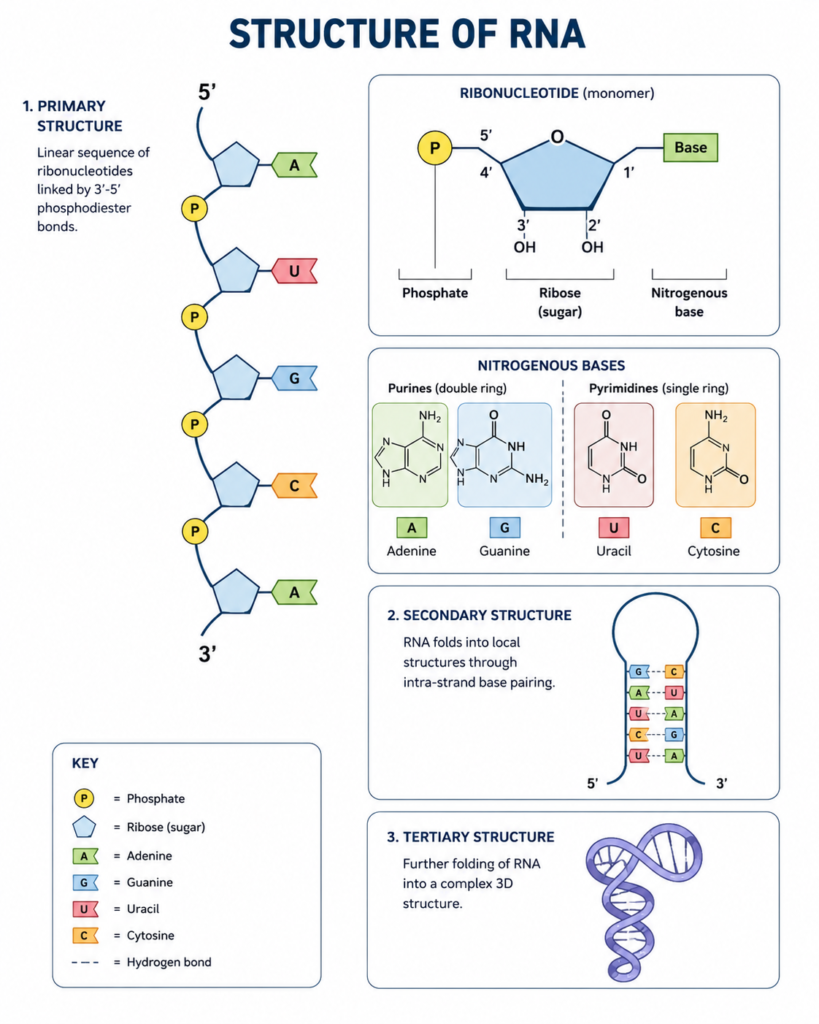
RNA stands for ribonucleic acid. Unlike DNA, RNA usually exists as a single strand.Moreover, It also contains ribose sugar instead of deoxyribose. Additionally, RNA uses uracil instead of thymine.
Moreover,several types of RNA exist in cells. Messenger RNA, or mRNA, carries genetic instructions from DNA. Ribosomal RNA, or rRNA, helps build proteins inside ribosomes.Moreover, Transfer RNA, or tRNA, brings amino acids to the ribosome during protein synthesis.
So,The comparison table below highlights key differences between DNA and RNA.
| Feature | DNA | RNA |
|---|---|---|
| Strand Type | Double strand | Single strand |
| Sugar | Deoxyribose | Ribose |
| Bases | A, T, G, C | A, U, G, C |
| Location | Mainly nucleus | Nucleus and cytoplasm |
| Function | Stores genetic code | Helps build proteins |
Because RNA is single-stranded, it can fold into complex shapes. Thus,These shapes help RNA molecules perform specialized functions. For example, tRNA folds into a cloverleaf shape. But,This shape allows precise amino acid delivery during translation.
Why This Biochemistry Matters in Dentistry
Healthy oral tissues depend on accurate DNA replication and RNA-based protein synthesis. For instance, gum tissue repair requires fast, accurate cell division. Similarly, enamel and dentin formation depend on coordinated gene expression. Therefore, any disruption in nucleic acids and nucleotides can affect oral tissue development.
Furthermore, certain dental diseases link to genetic mutations. These mutations often involve errors during DNA replication. As a result, understanding basic biochemistry helps dental professionals recognize underlying causes of certain conditions. But,This knowledge also supports better patient education and treatment planning.
Conclusion
Moreover,nucleic acids and nucleotides form the foundation of genetic biochemistry. Nucleotides combine to build long DNA and RNA chains.Futhermore, DNA stores genetic information inside a stable double helix.Thus, This DNA then organizes carefully into nucleosomes, chromatin, and chromosomes. Meanwhile, RNA translates genetic code into functional proteins through several specialized types. Together, these molecules explain how cells grow, repair, and reproduce.But, For dental professionals, this knowledge connects directly to tissue health, healing, and disease prevention. A clear grasp of nucleic acids and nucleotides ultimately supports stronger clinical understanding and better patient care.
Frequently Asked Questions
Nucleic acids and nucleotides are molecules that store and transmit genetic information. Moreover,Nucleotides act as building blocks, while nucleic acids form long chains like DNA and RNA.
A nucleotide contains a nitrogenous base, a five-carbon sugar, and a phosphate group.
DNA is double-stranded and uses deoxyribose sugar with thymine.But, RNA is single-stranded and uses ribose sugar with uracil instead.
DNA wraps around histone proteins to form nucleosomes. Moreover,These nucleosomes coil into chromatin, which condenses further into chromosomes during cell division.
Mostly, RNA carries genetic instructions from DNA, helps build ribosomes, and delivers amino acids during translation, making protein production possible.