Make a clear picture for compartments of body fluids
Water makes up most of the human body. In fact, body fluids account for nearly 60% of total body weight in an average adult. These fluids carry nutrients, remove waste, and keep every cell working properly.
Understanding body fluids is not just for medical students. Dentists, too, need this knowledge. Why? Because fluid balance affects healing, drug action, and even saliva production. So, let’s break down this topic step by step.
This guide covers compartments, composition, measurement techniques, and how the body maintains water balance. Additionally, we will look at applied physiology with real clinical examples.
Compartments of Body Fluids
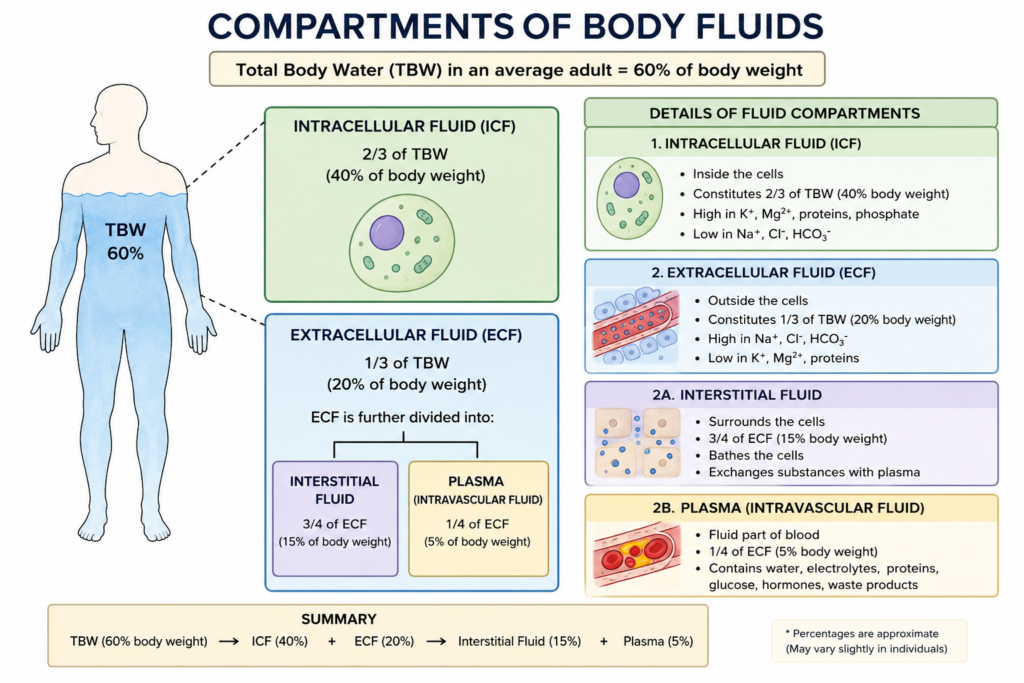
The body divides its fluid into two main compartments. Each compartment plays a distinct role.
1. Intracellular Fluid (ICF)
This fluid sits inside cells. It makes up about 40% of body weight. Potassium is the dominant ion here. Meanwhile, proteins and phosphates also contribute to its composition.
2. Extracellular Fluid (ECF)
This fluid surrounds the cells. It accounts for roughly 20% of body weight. Sodium dominates this compartment. The ECF further divides into:
- Plasma – the fluid portion of blood
- Interstitial fluid – fluid between cells and tissues
- Lymph – fluid drained by the lymphatic system
- Transcellular fluid – includes saliva, CSF, and synovial fluid
Here’s a quick visual breakdown:
Total Body Water (60% of body weight)
        |
        ├── Intracellular Fluid (40%)
        |
        └── Extracellular Fluid (20%)
                    |
                    ├── Plasma (5%)
                    ├── Interstitial Fluid (15%)
                    ├── Lymph
                    └── Transcellular Fluid
Notably, interstitial fluid acts as a bridge between blood and cells. Therefore, any imbalance here can disturb cellular function quickly.
Composition of Body Fluids
Each compartment has a unique chemical makeup. This difference drives essential processes like nerve conduction and muscle contraction.
| Component | Intracellular Fluid (ICF) | Extracellular Fluid (ECF) |
|---|---|---|
| Major cation | Potassium (K⁺) | Sodium (Na⁺) |
| Major anion | Phosphate, Protein | Chloride (Cl⁻), Bicarbonate |
| Protein content | High | Low (except plasma) |
| Volume (approx.) | 28 L | 14 L |
Sodium and potassium move across cell membranes through the sodium-potassium pump. This pump uses energy to maintain the ion gradient. As a result, nerve impulses and muscle contractions occur smoothly.
Plasma proteins, particularly albumin, also matter. They maintain oncotic pressure. This pressure pulls fluid back into blood vessels from tissues. Without it, fluid would leak excessively into tissues, causing edema.
Measurements of Body Fluid Volumes
Doctors and researchers use specific techniques to measure fluid volumes accurately. These methods rely on the dilution principle.
Dilution Method
A known substance is injected into the bloodstream. After it spreads evenly, its concentration is measured. Then, volume is calculated using this formula:
Volume = Amount of substance injected ÷ Concentration after dilution
Common Markers Used
| Fluid Compartment | Marker Used |
|---|---|
| Total Body Water | Deuterium oxide, Antipyrine |
| Extracellular Fluid | Inulin, Sodium thiosulfate |
| Plasma Volume | Evans blue dye, Radioactive albumin |
| Blood Volume | Calculated from plasma volume and hematocrit |
Interestingly, intracellular fluid volume cannot be measured directly. Instead, it’s calculated by subtracting ECF volume from total body water. This indirect method works well in clinical and research settings alike.
Maintenance of Water Balance
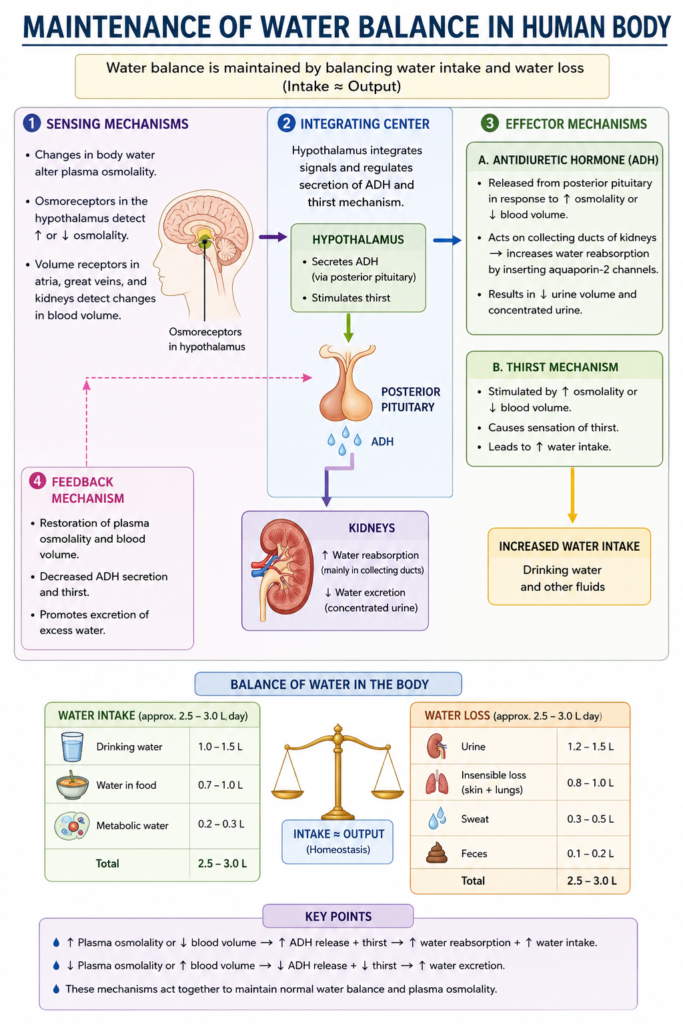
The body regulates water intake and output constantly. This balance prevents dehydration and fluid overload.
Water Intake Sources
- Drinking water and beverages
- Food (especially fruits and vegetables)
- Metabolic water (produced during cellular respiration)
Water Output Routes
- Urine (major route)
- Sweat
- Respiration (water vapor)
- Feces
Hormonal Control
Several hormones regulate this balance precisely:
- Antidiuretic Hormone (ADH) – Increases water reabsorption in kidneys
- Aldosterone – Promotes sodium and water retention
- Atrial Natriuretic Peptide (ANP) – Promotes sodium and water excretion
When blood becomes concentrated, osmoreceptors in the hypothalamus detect this change. Consequently, thirst increases, and ADH release rises. This dual response restores normal fluid concentration quickly.
Below is a simple flowchart of this regulation:
Increased Plasma Osmolarity
            |
            ▼
  Hypothalamus Osmoreceptors Activated
            |
            ▼
   ADH Release + Thirst Sensation
            |
            ▼
  Increased Water Reabsorption (Kidneys)
            |
            ▼
   Plasma Osmolarity Normalized
This feedback loop runs continuously. Thus, the body maintains stable fluid levels despite varying intake throughout the day.
Applied Physiology
Clinical conditions often arise from disturbances in body fluids. Dentists and physicians both encounter these scenarios.
Dehydration
When fluid loss exceeds intake, dehydration occurs. Dry mouth, reduced saliva flow, and increased thirst are common signs. For dental patients, this can complicate procedures and affect oral healing.
Edema
Excess fluid accumulates in tissues during edema. Low plasma protein, increased capillary pressure, or lymphatic blockage can all cause this. Facial swelling after dental surgery sometimes reflects local fluid shifts.
Electrolyte Imbalance
Abnormal sodium or potassium levels disrupt nerve and muscle function. This imbalance can affect anesthesia response during dental treatments. Therefore, monitoring electrolytes matters before major procedures.
Relevance to Dental Practice
Saliva, a transcellular fluid, depends heavily on proper hydration and electrolyte balance. Reduced fluid volume often leads to xerostomia (dry mouth). This condition increases the risk of cavities and gum disease. So, maintaining fluid balance directly supports oral health.
Conclusion
Body fluids form the foundation of human physiology. They support cellular function, nutrient transport, and waste removal. Understanding compartments, composition, and regulation helps explain many clinical conditions, including those relevant to dental care.
From dehydration to electrolyte imbalances, fluid disturbances can affect treatment outcomes significantly. Hence, both dental professionals and patients benefit from understanding how the body manages water balance daily. A well-hydrated body, after all, supports a healthier smile.
Frequently Asked Questions (FAQs)
The two main compartments are intracellular fluid (inside cells) and extracellular fluid (outside cells, including plasma and interstitial fluid).
Sodium is the dominant ion in extracellular fluid, while potassium dominates intracellular fluid.
Plasma volume is measured using dye dilution techniques, commonly with Evans blue dye or radioactive albumin tracers.
Antidiuretic hormone (ADH) helps the kidneys reabsorb more water, reducing urine output and conserving body fluid.
Proper fluid balance supports normal saliva production. Dehydration reduces saliva flow, increasing the risk of dry mouth, cavities, and gum problems