How Coagulation of Blood Protects Your Body
Cuts happen every day. A kitchen accident, a paper cut, a scraped knee — small wounds are part of life. Yet within minutes, the bleeding stops on its own. This quiet, remarkable process is called coagulation of blood.
Most people never think about it until something goes wrong. However, this system works constantly behind the scenes to keep you safe. Without it, even a minor injury could turn dangerous.
In this article, we will break down how blood clotting works, why it matters, and what can happen when the process fails. We will also look at common disorders, practical tips, and answers to frequently asked questions.
What Is Coagulation of Blood?
Coagulation of blood is the body’s natural way of stopping bleeding after an injury. It transforms liquid blood into a gel-like clot. This clot seals damaged blood vessels and prevents excessive blood loss.
The process involves several players working together. These include platelets, clotting factors, and the walls of blood vessels themselves. Each one has a specific job.
First, the blood vessel narrows to slow blood flow. Then, platelets rush to the site and stick together. Finally, a web of protein fibers locks everything in place. Together, these steps form a strong, stable clot.
Interestingly, this system must stay balanced. Too little clotting leads to dangerous bleeding. Too much clotting can block blood vessels entirely. As a result, the body constantly fine-tunes this delicate process.
The Blood Clotting Process: Step by Step
Understanding coagulation of blood becomes easier when you break it into stages. Scientists typically describe three main phases.
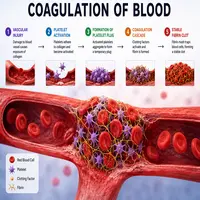
Stage 1: Vascular Spasm The injured blood vessel immediately constricts. This narrowing reduces blood flow to the damaged area. Consequently, less blood escapes while the body prepares its next response.
Stage 2: Platelet Plug Formation Small cell fragments called platelets arrive quickly. They stick to the exposed tissue and to each other. This creates a temporary plug. Meanwhile, chemical signals attract even more platelets to strengthen the seal.
Stage 3: Coagulation Cascade This final stage involves a chain reaction of clotting factors. These proteins activate one another in a specific sequence. Eventually, fibrinogen converts into fibrin, forming a mesh that traps blood cells and hardens the clot.
Below is a simplified flow of the process:
Blood Vessel Injury
        |
        v
Vascular Spasm (vessel narrows)
        |
        v
Platelets Stick to Injury Site
        |
        v
Platelet Plug Forms
        |
        v
Clotting Factors Activate (Cascade)
        |
        v
Fibrinogen Converts to Fibrin
        |
        v
Stable Blood Clot Forms
This sequence usually takes just a few minutes. Nevertheless, any disruption at any stage can delay healing or trigger complications.
Clotting Factors Involved
Several proteins, known as clotting factors, drive this cascade forward. Doctors number them using Roman numerals. The table below summarizes the major ones.
| Factor Number | Common Name | Main Role |
|---|---|---|
| Factor I | Fibrinogen | Forms fibrin mesh |
| Factor II | Prothrombin | Converts to thrombin |
| Factor III | Tissue Factor | Starts the cascade |
| Factor IV | Calcium Ions | Supports reactions |
| Factor VIII | Antihemophilic Factor | Missing in hemophilia A |
| Factor IX | Christmas Factor | Missing in hemophilia B |
| Factor X | Stuart-Prower Factor | Activates thrombin |
Each factor depends on the ones before it. Therefore, a missing or faulty factor can break the entire chain. This is exactly what happens in certain genetic bleeding disorders.
Common Disorders Related to Coagulation of Blood
Sometimes, this finely tuned system malfunctions. Genetics, illness, or medication can all play a role.
Hemophilia is perhaps the most well-known disorder. People with this condition lack specific clotting factors, usually Factor VIII or IX. As a result, even small injuries can cause prolonged bleeding.
Von Willebrand Disease affects a protein that helps platelets stick together. Similarly, this leads to easy bruising and extended bleeding after cuts or surgery.
Thrombophilia, on the other hand, causes the opposite problem. This condition makes blood clot too easily. Consequently, patients face a higher risk of dangerous clots in veins or arteries.
Vitamin K deficiency can also interfere with clotting. Since several clotting factors depend on vitamin K, low levels can slow the entire process significantly.
Below is a quick comparison:
| Disorder | Effect on Coagulation | Main Risk |
|---|---|---|
| Hemophilia | Delayed clotting | Excessive bleeding |
| Von Willebrand Disease | Weak platelet function | Easy bruising |
| Thrombophilia | Excessive clotting | Blood clots, strokes |
| Vitamin K Deficiency | Slower factor activation | Prolonged bleeding |
How to Support Healthy Blood Coagulation
Fortunately, everyday habits can support this system. A balanced diet rich in vitamin K, found in leafy greens, helps maintain proper clotting factor production.
Staying hydrated also matters. Additionally, regular movement keeps blood flowing smoothly and lowers the risk of unwanted clots forming in the legs.
Avoiding smoking is another important step. Smoking damages blood vessels and disrupts normal clotting balance. Meanwhile, managing chronic conditions like diabetes helps protect vascular health overall.
For those on blood-thinning medication, following a doctor’s guidance is essential. Sudden dietary changes involving vitamin K can interfere with these medications. Therefore, consistency matters more than avoidance.
When to See a Doctor
Certain warning signs deserve prompt attention. These include unexplained bruising, prolonged bleeding from minor cuts, or blood in urine or stool.
Frequent nosebleeds can also signal an underlying issue. Similarly, swelling or pain in one leg may indicate a blood clot. In such cases, seeking medical advice quickly is important.
Doctors can run simple blood tests to check clotting times and factor levels. Early diagnosis often leads to better outcomes and simpler treatment options.
Conclusion
Coagulation of blood is one of the body’s most impressive survival mechanisms. It quietly protects you from every small scrape and major injury alike. From vascular spasms to the final fibrin mesh, each step matters.
When this system works well, you barely notice it. When it fails, however, the consequences can be serious. Understanding how it functions helps you recognize warning signs early and take better care of your health.
Ultimately, a balanced diet, healthy habits, and regular checkups all support this vital process. Your body works hard to protect you — a little awareness goes a long way in return.
Frequently Asked Questions
It is the process where blood changes from a liquid into a gel-like clot to stop bleeding after an injury.
Typically, the process takes a few minutes, though it can vary based on individual health and injury severity.
Vitamin K plays a key role, since several clotting factors depend on it for proper function.
Yes, chronic stress can influence clotting factors and blood vessel function, potentially increasing clotting risk over time.
Leafy greens, broccoli, and foods rich in vitamin K support healthy clotting factor production naturally.