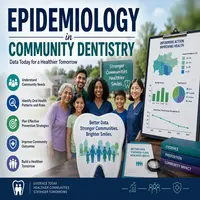
Epidemiology in Community Dentistry
Public health decisions rely heavily on data. Dentists and health officials need to know how diseases spread within populations. This is where epidemiology becomes essential in community dentistry.
Epidemiology studies disease patterns across groups of people. It helps identify causes, risk factors, and prevention strategies. This article explains its core principles and applications in dental public health. Additionally, it covers study types, measurement tools, and real-world uses. By the end, you will understand why this field remains central to community oral health programs.
What Is Epidemiology?
Epidemiology is the study of disease distribution within populations. It focuses on who gets sick, where, and why. Unlike clinical dentistry, it looks beyond individual patients toward entire communities.
This field examines patterns using measurable data. For instance, researchers track disease frequency across different age groups. Similarly, they study geographic differences in oral disease rates. Therefore, epidemiology provides a broader view of dental health trends.
Moreover, this science helps identify risk factors linked to disease. Diet, hygiene habits, and fluoride exposure often appear as key variables. As a result, health officials can target prevention programs more effectively.
Understanding these basics shows why epidemiology plays such an important role in dental public health planning.
Key Measures Used in Epidemiology
Several important measures help quantify disease within populations. These measures allow accurate comparisons across different groups and regions.
First, prevalence measures how many people have a disease at a specific time. Second, incidence measures new cases occurring within a set period. Third, mortality rate tracks disease-related deaths within a population.
The table below summarizes these key epidemiological measures clearly.
| Measure | Definition | Example Use in Dentistry |
|---|---|---|
| Prevalence | Existing cases at a given time | Percentage of adults with cavities today |
| Incidence | New cases over a set period | New gum disease cases per year |
| Mortality Rate | Deaths related to a condition | Oral cancer death rates annually |
| Morbidity Rate | Illness burden within a group | Tooth loss rates among elderly patients |
These measures guide health planners toward effective, targeted interventions. Furthermore, they help track progress over time within specific communities.
Types of Epidemiological Studies
Researchers use different study designs depending on their goals. Each design offers unique strengths and limitations.
Firstly, descriptive studies observe patterns without testing causes directly. They simply describe who, what, when, and where. Secondly, analytical studies go further by testing relationships between exposure and disease.
Within analytical studies, two common types exist. Cohort studies follow groups over time to observe outcomes. Case-control studies compare people with and without disease to identify past exposures.
Below is a simple flowchart showing this classification:
Epidemiological Study Designs
            |
   -------------------
   |                 |
Descriptive       Analytical
Studies           Studies
(Observe patterns)     |
              -------------------
              |                 |
          Cohort            Case-Control
          Studies            Studies
      (Follow forward)   (Look backward)
This structure helps researchers choose the right approach for each research question.
Applications in Community Dentistry
Epidemiology plays a practical role in dental public health programs. Firstly, it helps identify communities with high cavity rates. This information guides targeted fluoride programs.
Secondly, it supports oral cancer screening initiatives. Health officials use data to focus resources where risk appears highest. Thirdly, epidemiological data guides school dental health programs effectively.
Additionally, this field helps evaluate program success over time. For example, officials compare disease rates before and after interventions. Consequently, epidemiology directly shapes policy decisions and funding priorities.
Challenges in Dental Epidemiology
Despite its usefulness, this field faces certain challenges. First, data collection can be inconsistent across regions. Some areas lack proper reporting systems entirely.
Moreover, cultural and behavioral factors complicate accurate measurement. People may underreport symptoms due to stigma or limited awareness. Similarly, access to dental care varies widely, affecting recorded disease rates.
Nevertheless, ongoing improvements in data systems continue strengthening this field. Digital record-keeping now helps researchers gather more reliable information. Therefore, future studies should become increasingly accurate and useful.
Conclusion
Epidemiology remains a cornerstone of community dentistry. It helps identify disease patterns, risk factors, and effective prevention strategies. Without this science, public health planning would lack essential direction.
Understanding key measures and study designs helps professionals interpret dental health data correctly. This knowledge supports better policy decisions and resource allocation. Ultimately, epidemiology continues shaping healthier communities through evidence-based dental care.
As technology advances, data collection will likely become faster and more accurate. This progress will further strengthen prevention efforts worldwide.
Frequently Asked Questions
It is the study of how diseases spread and affect groups of people, helping identify causes and prevention methods.
It helps identify oral disease patterns, guiding public health programs like fluoride initiatives and screening campaigns.
Prevalence measures existing cases at one time, while incidence measures new cases over a specific period.
The main types include descriptive studies, cohort studies, and case-control studies, each serving different research purposes.
It provides data that guides resource allocation, screening priorities, and program evaluation within community dental health initiatives.