Properties of Skeletal Muscles: A Clear Guide
Have you ever wondered how your body manages to lift, run, and even smile? The answer lies in the properties of skeletal muscles. These tissues allow movement, maintain posture, and generate heat. This guide explains each property in simple terms. You will find tables, a flowchart, and answers to common questions below.
What Makes This Tissue Unique
Unlike smooth or cardiac tissue, this type attaches to bones through tendons. It works under voluntary control, meaning you decide when to use it. Meanwhile, it also responds instantly to signals from the nervous system.
Structurally, long fibers run parallel to each other, giving the tissue a striped appearance under a microscope. Therefore, scientists often call it striated tissue. This structure allows strong, coordinated contractions.
Four Core Functional Characteristics
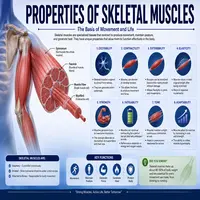
This tissue’s function starts with four key characteristics. Each one plays a distinct role in movement and stability.
| Property | Description |
|---|---|
| Excitability | Ability to respond to nerve signals |
| Contractility | Ability to shorten and generate force |
| Extensibility | Ability to stretch without damage |
| Elasticity | Ability to return to original length |
As shown above, these four traits work together during every movement. However, an imbalance in any one of them can lead to injury or dysfunction.
How Contraction Actually Happens
Contraction begins when a nerve signal reaches the tissue through a neuromuscular junction. This signal triggers calcium release inside the fibers. Consequently, protein filaments slide past each other, shortening the fiber.
This process, often called the sliding filament mechanism, requires energy in the form of ATP. Without enough energy, fibers cannot relax properly after contracting. As a result, cramps or fatigue may occur during intense activity.
A Simple Flowchart of Muscle Contraction
Seeing the sequence visually often makes the process easier to understand. Here is a basic flowchart:
Nerve Impulse Reaches Neuromuscular Junction
        ↓
Calcium Ions Released Inside Fiber
        ↓
Protein Filaments Bind and Slide
        ↓
Fiber Shortens, Force Is Generated
        ↓
ATP Powers Filament Release
        ↓
Fiber Relaxes and Returns to Rest
Each step depends on the one before it. Additionally, any disruption in this chain can weaken overall performance.
Fiber Types and Their Roles
Not all fibers behave the same way. Some specialize in endurance, while others focus on quick, powerful bursts. Below is a simple comparison:
| Fiber Type | Speed | Best Suited For |
|---|---|---|
| Type I (Slow-Twitch) | Slow | Endurance activities, posture |
| Type IIa (Fast-Twitch) | Moderate | Mixed activities, sprinting with recovery |
| Type IIx (Fast-Twitch) | Fast | Short, powerful bursts |
Athletes often have a higher ratio of one fiber type based on their sport. For instance, marathon runners typically show more slow-twitch fibers, while sprinters show more fast-twitch fibers.
Factors That Influence Performance
Several factors affect how well this tissue performs over time. Genetics plays a role in determining fiber type ratios. Meanwhile, training, nutrition, and hydration significantly influence strength and endurance.
- Age – strength typically peaks in early adulthood
- Nutrition – protein supports repair and growth
- Training type – resistance work builds strength, endurance work builds stamina
- Hydration – supports proper electrolyte balance during contraction
- Rest – recovery periods allow fiber repair and adaptation
Because these factors interact closely, professionals often recommend balanced training programs. Consistent rest, in particular, prevents overuse injuries.
Common Issues Linked to Dysfunction
Sometimes normal function breaks down due to injury, disease, or overuse. Common issues include the following:
- Strains – overstretching causes fiber tears
- Cramps – sudden, involuntary contractions occur
- Atrophy – lack of use leads to tissue shrinkage
- Fatigue – prolonged activity depletes energy stores
Addressing these issues early often prevents long-term complications. Therefore, proper warm-up routines and gradual training increases matter significantly.
Supporting Healthy Function Naturally
Simple daily habits support long-term tissue health. Regular strength training encourages growth and repair. Balanced nutrition, especially adequate protein intake, supports recovery after exercise.
Stretching before and after activity helps maintain flexibility. Furthermore, staying hydrated supports proper electrical signaling during contraction. These small, consistent habits often make a significant difference over time.
Conclusion
These functional traits explain how the body moves, stabilizes, and generates force every single day. From excitability to elasticity, each characteristic plays a distinct role in overall performance. Understanding fiber types, contraction mechanisms, and common issues helps explain why training and recovery matter so much. By supporting this tissue through proper nutrition, hydration, and rest, you protect one of your body’s most essential systems. Small, consistent habits often lead to noticeably better strength, endurance, and long-term mobility.
Frequently Asked Questions
Excitability, contractility, extensibility, and elasticity are the four core characteristics involved in movement.
Genetics influences fiber type ratios, which affects how quickly someone builds strength or endurance.
Cramps often result from dehydration, electrolyte imbalance, or fatigue during intense activity.
Yes, consistent resistance training and proper nutrition can often rebuild lost strength and size over time.
Rest allows fibers to repair and adapt, which ultimately improves strength and reduces injury risk.