DNA Replication Explained: Process, Steps, and Importance
Every living cell carries a secret copying machine. It works nonstop, and it rarely makes a mistake. This machine copies the genetic code before a cell divides. Scientists call this process DNA replication.
In this article, we break down how cells copy their genetic material. We cover the enzymes involved, the steps of the process, and why accuracy matters so much. We also include tables, a flowchart, and answers to common questions.
What Is DNA Replication?
DNA replication is the biological process where a cell copies its DNA before division. Each new cell needs a complete, accurate set of genetic instructions. Without this copying step, cells could not grow, repair tissue, or reproduce.
The double helix structure makes this copying possible. Each strand of DNA acts as a template. Consequently, the two new molecules end up identical to the original. This method is called semi-conservative replication because each new DNA molecule keeps one original strand and gains one new strand.
Where Does Replication Happen?
Replication occurs in the nucleus of eukaryotic cells. In bacteria, it happens in the cytoplasm since these cells lack a nucleus. Either way, the process starts at specific points on the DNA molecule called origins of replication.
Human cells contain multiple origins on each chromosome. Meanwhile, bacterial cells usually have just one origin per circular chromosome. This difference speeds up copying in complex organisms with much larger genomes.
Key Enzymes and Proteins Involved

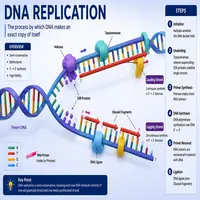
Several proteins work together like a well-trained team. Each one performs a specific job. The table below summarizes the main players.
| Enzyme/Protein | Main Function |
|---|---|
| Helicase | Unwinds and separates the DNA double helix |
| Single-strand binding proteins | Stabilize separated strands and prevent rejoining |
| Primase | Builds short RNA primers to start synthesis |
| DNA Polymerase III | Adds new nucleotides to the growing strand |
| DNA Polymerase I | Replaces RNA primers with DNA |
| Ligase | Seals gaps between DNA fragments |
| Topoisomerase | Relieves twisting stress ahead of the replication fork |
Together, these molecules form a fast and accurate copying system. Without any single one, the process would stall or produce errors.
The Replication Process: Step by Step

The process unfolds in a clear sequence. Below is a simple flowchart of the main stages.
Origin Recognition
        |
        v
Helicase Unwinds DNA (Replication Fork Forms)
        |
        v
Single-Strand Binding Proteins Stabilize Strands
        |
        v
Primase Adds RNA Primers
        |
        v
DNA Polymerase III Builds New Strands
        |
        v
Leading Strand Synthesized Continuously
Lagging Strand Synthesized in Fragments (Okazaki Fragments)
        |
        v
DNA Polymerase I Replaces Primers with DNA
        |
        v
Ligase Joins Fragments Together
        |
        v
Two Identical DNA Molecules Formed
Step 1: Initiation
The process begins at the origin of replication. Helicase enzymes unwind the double helix, creating a Y-shaped structure known as the replication fork. Topoisomerase relieves tension ahead of the fork so the strands don’t tangle.
Step 2: Primer Binding
Primase lays down short RNA primers. These primers give DNA polymerase a starting point. Without a primer, the polymerase enzyme cannot begin adding nucleotides.
Step 3: Elongation
DNA polymerase III now takes over. It reads each template strand and adds matching nucleotides. The leading strand gets copied smoothly in one continuous piece. The lagging strand, however, gets copied in short bursts called Okazaki fragments.
This difference happens because DNA polymerase only works in one direction. Therefore, one strand must be built backward in pieces, then stitched together later.
Step 4: Primer Removal and Replacement
DNA polymerase I removes the RNA primers. It then fills those gaps with proper DNA nucleotides. This step ensures the final molecule contains only DNA, not leftover RNA fragments.
Step 5: Ligation
Finally, ligase seals any remaining gaps between fragments. The result is a smooth, continuous strand of DNA. At this point, two complete DNA molecules exist where there was originally one.
Why Accuracy Matters So Much
Cells cannot afford sloppy copying. A single mistake in a critical gene can cause disease or malfunction. Fortunately, DNA polymerase has a built-in proofreading function. It checks each new nucleotide and removes incorrect matches immediately.
Additionally, cells use separate repair systems after replication finishes. These systems scan the new DNA for errors that slipped past proofreading. Thanks to these safeguards, the overall error rate stays incredibly low, often less than one mistake per billion nucleotides.
Common Errors and Their Consequences
Sometimes, replication does go wrong. Mutations can occur when the wrong nucleotide gets added and slips past repair. Other errors include insertions, deletions, or slippage during copying of repetitive sequences.
These mistakes are not always harmful. Some mutations are silent and cause no noticeable change. Others, though, contribute to genetic disorders or, in rare cases, cancer. Understanding this process helps researchers develop better treatments and diagnostic tools.
Comparing Replication in Prokaryotes and Eukaryotes
| Feature | Prokaryotes | Eukaryotes |
|---|---|---|
| Location | Cytoplasm | Nucleus |
| Number of origins | Single origin | Multiple origins |
| Speed | Faster | Slower |
| Chromosome shape | Circular | Linear |
| Telomere concern | None | Yes, requires telomerase |
Eukaryotic cells face an extra challenge with linear chromosomes. The ends, called telomeres, shorten slightly with each round of copying. An enzyme called telomerase helps offset this shortening in certain cell types, such as stem cells and germ cells.
Real-World Applications
Understanding this copying mechanism has practical value far beyond textbooks. Scientists use similar principles in PCR (polymerase chain reaction), a lab technique that amplifies DNA samples. This technique supports genetic testing, forensic science, and disease diagnosis.
Furthermore, cancer treatments often target rapidly dividing cells by disrupting their ability to copy DNA accurately. Antiviral drugs also work by blocking similar enzymes in viruses. Clearly, this single biological process touches medicine, forensics, and biotechnology alike.
Conclusion
DNA replication keeps life running smoothly. It ensures that every new cell receives a complete, accurate genetic blueprint. From helicase unwinding the helix to ligase sealing the final gaps, each step relies on precise teamwork between enzymes.
This process also shapes fields well beyond basic biology, including medicine, genetics research, and forensic science. A solid grasp of these steps helps students, researchers, and curious readers appreciate how life sustains itself at the molecular level. The next time you think about growth or healing, remember: it all starts with this remarkable copying process.
Frequently Asked Questions
The main purpose is to produce two identical copies of DNA before cell division. This ensures each daughter cell receives a complete set of genetic instructions.
Each new DNA molecule contains one original strand and one newly made strand. Scientists call this pattern semi-conservative because half of the original molecule is preserved.
Helicase performs this job. It breaks the hydrogen bonds between base pairs and separates the two strands, creating the replication fork.
Most errors get caught and fixed by proofreading and repair mechanisms. However, some errors persist and become mutations, which can be harmless or, occasionally, harmful.
Bacteria replicate faster and use a single origin point on a circular chromosome. Human cells use multiple origins on linear chromosomes, which allows large genomes to be copied efficiently despite added complexity, such as telomere maintenance