Metabolism of Amino Acids: A Complete Guide
Proteins do not last forever inside the body. They break down, rebuild, and constantly cycle through different chemical pathways. At the center of this process lies the metabolism of amino acids, a topic every biochemistry student eventually must master.
This process fuels energy production, supports tissue repair, and even helps regulate blood sugar levels. In this guide, we will explore how amino acids get broken down, used, and converted into other essential molecules.
What Is the Metabolism of Amino Acids?
The metabolism of amino acids involves a series of chemical reactions that break down proteins into usable energy or building blocks. These reactions occur constantly, even when we are not eating protein-rich meals.
Once proteins are digested, they release individual amino acids into the bloodstream. From there, cells absorb these molecules and direct them toward multiple pathways. Some amino acids get used to build new proteins, while others undergo breakdown for energy.
Because the body cannot store amino acids like it stores fat, excess amounts must be processed quickly. Consequently, the liver plays a central role in managing this constant turnover.
Digestion and Absorption Before Metabolism Begins
Before metabolism starts, proteins must first be broken down through digestion. Enzymes like pepsin, trypsin, and chymotrypsin split large proteins into smaller peptides and free amino acids.
These smaller units then travel to the small intestine, where specific transporters absorb them into intestinal cells. Afterward, amino acids enter the bloodstream and travel toward the liver for further processing.
Interestingly, not all amino acids follow the same path. Branched-chain amino acids, for instance, often bypass the liver and go directly to muscle tissue for energy use.
Key Steps in Amino Acid Breakdown
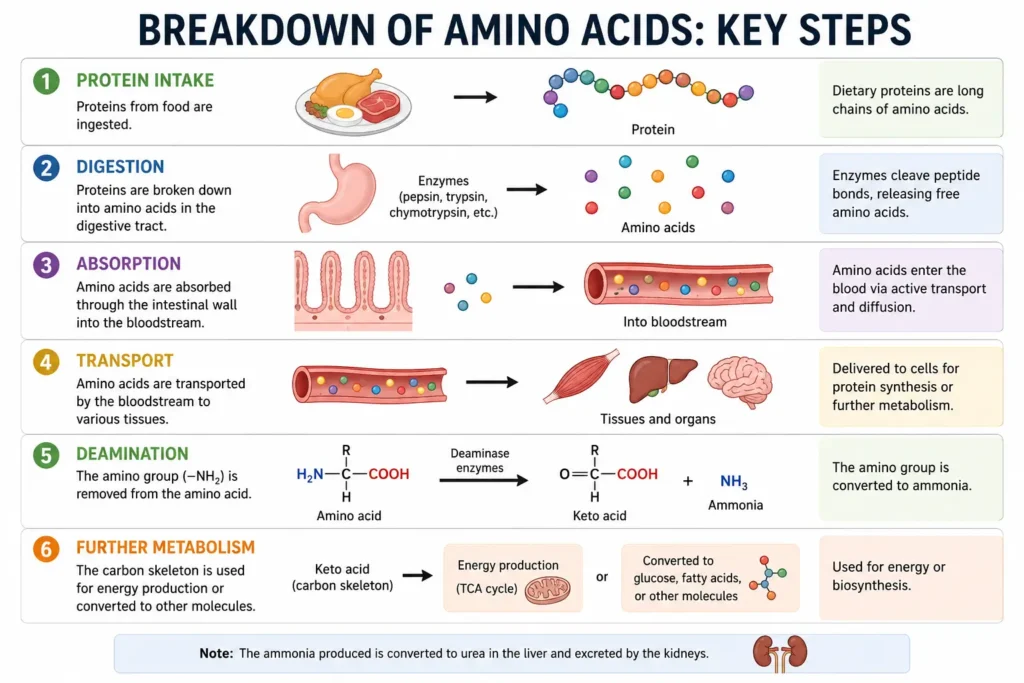
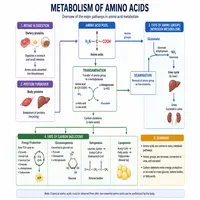
Once inside cells, amino acids undergo two major initial steps: transamination and deamination. Both processes remove the amino group before the remaining carbon skeleton enters energy pathways.
Here is a simple flowchart showing this process:
Dietary Protein
        ↓
Digestion into Amino Acids
        ↓
Transamination (Amino Group Transfer)
        ↓
Deamination (Ammonia Release)
        ↓
Urea Cycle (Ammonia Detoxification)
        ↓
Carbon Skeleton Enters Krebs Cycle
This flowchart highlights how nitrogen removal connects directly to the urea cycle. Meanwhile, the leftover carbon skeleton often enters the citric acid cycle for energy production.
Additionally, this process prevents toxic ammonia buildup in the bloodstream. Without proper detoxification, ammonia can become dangerous, especially for brain function.
The Urea Cycle and Nitrogen Disposal
Ammonia produced during deamination is highly toxic. Therefore, the liver converts it into urea through a process called the urea cycle. This cycle allows safe removal of nitrogen waste through urine.
The urea cycle occurs in five main steps, involving both the mitochondria and cytoplasm of liver cells. Each step requires specific enzymes, and any deficiency can lead to serious metabolic disorders.
Below is a simplified summary of this cycle:
| Step | Location | Key Molecule Formed |
|---|---|---|
| Step 1 | Mitochondria | Carbamoyl phosphate |
| Step 2 | Mitochondria | Citrulline |
| Step 3 | Cytoplasm | Argininosuccinate |
| Step 4 | Cytoplasm | Arginine |
| Step 5 | Cytoplasm | Urea and ornithine |
This table shows how nitrogen waste moves through multiple cellular compartments before final elimination.
Fate of Carbon Skeletons
After nitrogen removal, the remaining carbon skeletons follow different fates depending on their structure. Some become glucogenic, meaning they can be converted into glucose. Others are ketogenic, meaning they form ketone bodies instead.
A few amino acids are both glucogenic and ketogenic, depending on metabolic needs. This flexibility allows the body to adapt during fasting, exercise, or illness.
The table below categorizes amino acids by their metabolic fate:
| Category | Examples | Fate |
|---|---|---|
| Glucogenic | Alanine, glycine, serine | Converted into glucose |
| Ketogenic | Leucine, lysine | Converted into ketone bodies |
| Both | Isoleucine, phenylalanine | Either pathway, depending on need |
This classification helps explain why certain amino acids become more important during starvation or diabetic conditions.
Clinical Relevance of Amino Acid Metabolism
Disorders in this pathway can lead to serious health issues. For example, deficiencies in urea cycle enzymes cause ammonia buildup, leading to confusion, vomiting, or even coma in severe cases.
Similarly, conditions like phenylketonuria occur when the body cannot properly break down phenylalanine. Without treatment, this buildup can cause intellectual disability in children.
Moreover, understanding the metabolism of amino acids helps doctors manage liver disease. Since the liver plays a central role in nitrogen processing, liver dysfunction often leads to elevated ammonia levels in the blood.
Why This Process Matters for Overall Health
This metabolic pathway does more than just break down protein. It supports blood sugar regulation, muscle repair, and detoxification of harmful byproducts. Without it, the body would struggle to maintain balance during fasting or intense physical activity.
Additionally, athletes and bodybuilders often study this pathway closely. Branched-chain amino acids, in particular, play a major role in muscle recovery and energy production during exercise.
Therefore, maintaining balanced protein intake supports not just muscle growth, but also proper nitrogen balance throughout the body.
Conclusion
The metabolism of amino acids forms a critical part of everyday biochemistry, connecting protein intake to energy production, detoxification, and blood sugar control. From digestion to the urea cycle, each step plays a specific role in maintaining balance within the body.
For students, mastering this pathway builds a strong foundation for understanding metabolic diseases. For healthcare professionals, recognizing disruptions in this process helps diagnose conditions ranging from liver disease to rare genetic disorders. Ultimately, this pathway reminds us how deeply connected nutrition and biochemistry truly are.
Frequently Asked Questions
It is the process through which the body breaks down amino acids for energy, detoxification, or conversion into other molecules.
The urea cycle safely converts toxic ammonia into urea, allowing the body to remove nitrogen waste through urine.
Disorders can lead to ammonia buildup, intellectual disability, or other serious metabolic diseases, depending on the specific defect.
No. Some become glucogenic, forming glucose, while others become ketogenic, forming ketone bodies instead.
Branched-chain amino acids play a key role in muscle recovery, making this pathway important for exercise performance and recovery.