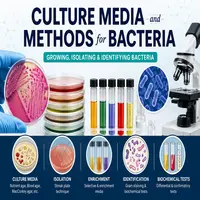
Culture Media and Methods for Bacteria: A Complete Guide
Bacteria are invisible to the naked eye, yet they leave clear evidence when grown in the right conditions. Laboratories rely on culture media and methods for bacteria to identify infections, study organisms, and guide treatment decisions.
Without these tools, diagnosing bacterial infections would be far more difficult. In this guide, we explore the types of media used and common culturing techniques. We also look at why this process stays central to modern pathology.
Defining the Term
In simple words, culture media and methods for bacteria are the nutrient-rich substances and techniques used to grow microorganisms in a lab. These media supply everything bacteria need. This includes nutrients, moisture, and the right pH balance.
After inoculation onto suitable media, bacteria multiply into visible colonies. Scientists then study these colonies to identify the organism, test its sensitivity to antibiotics, and understand its behavior.
Because different bacteria require different conditions, laboratories use a wide range of media types. Selecting the correct one often determines whether an organism grows successfully or not.
Basic Requirements for Bacterial Growth
Before exploring specific media types, it helps to understand what bacteria generally need to survive and multiply. Most bacteria require a source of carbon, nitrogen, moisture, and specific temperature ranges.
Additionally, oxygen requirements vary widely between species. Some bacteria thrive in oxygen-rich environments, while others survive only without oxygen. Consequently, laboratories must adjust conditions depending on the suspected organism.
The table below summarizes these basic growth requirements:
| Requirement | Purpose |
|---|---|
| Carbon source | Provides energy for growth |
| Nitrogen source | Supports protein synthesis |
| Moisture | Maintains cellular activity |
| Correct pH | Supports enzyme function |
| Suitable temperature | Enables optimal metabolic activity |
This table highlights why even small changes in conditions can prevent successful bacterial growth.
Types of Culture Media
Laboratories use several categories of media, each designed for a specific purpose. Understanding these categories helps explain why certain media get chosen over others.
Below is a simple breakdown of common types:
| Media Type | Purpose | Example |
|---|---|---|
| Simple media | General growth support | Nutrient broth |
| Enriched media | Supports fastidious organisms | Blood agar |
| Selective media | Suppresses unwanted organisms | MacConkey agar |
| Differential media | Distinguishes between species | Eosin methylene blue agar |
| Transport media | Preserves samples during transit | Cary-Blair medium |
Each type plays a distinct role in the diagnostic process. Therefore, choosing the right media often depends on the suspected infection and sample type.
Common Culturing Methods
Beyond media selection, technique also matters greatly. Laboratories rely on established methods to isolate and identify bacteria accurately.
Here is a simplified flowchart showing a typical culturing process:
Sample Collection
        ↓
Inoculation onto Suitable Media
        ↓
Incubation at Optimal Temperature
        ↓
Colony Growth Observation
        ↓
Identification and Sensitivity Testing
This flowchart outlines the general path most samples follow, from collection to final identification. Meanwhile, each step requires careful handling to avoid contamination.
Streak plate methods remain among the most common techniques used to isolate single colonies. This method involves spreading a sample across the plate in a specific pattern, gradually diluting bacteria to separate individual colonies.
Incubation Conditions and Their Importance
After inoculation, samples require incubation under specific conditions. Temperature, oxygen levels, and duration all influence how well bacteria grow.
Most human pathogens grow best around body temperature, typically between thirty-five and thirty-seven degrees Celsius. However, some organisms require different conditions entirely, such as lower temperatures or extended incubation periods.
Furthermore, laboratories must consider oxygen requirements carefully. Anaerobic organisms, for instance, need special chambers or jars that remove oxygen completely. Without these adjustments, such bacteria simply fail to grow.
Identification After Growth
Once colonies appear, laboratories move toward identification. This stage often combines several approaches, including colony appearance, staining techniques, and biochemical testing.
Gram staining remains one of the most widely used identification tools. This method separates bacteria into Gram positive and Gram negative categories based on cell wall structure, guiding further testing decisions.
Additionally, biochemical tests help confirm species identity. These tests examine how bacteria metabolize specific substances, producing distinct reactions that assist in accurate classification.
Clinical Importance of Proper Culturing Techniques
Accurate use of culture media and methods for bacteria directly impacts patient care. Misidentifying an organism can lead to incorrect treatment, potentially worsening infections or promoting antibiotic resistance.
Moreover, sensitivity testing performed after culturing helps doctors choose effective antibiotics. Without this step, treatment often relies on guesswork rather than solid evidence.
Therefore, laboratories must follow strict protocols throughout collection, culturing, and identification to ensure reliable results.
Challenges in Bacterial Culturing
Despite advances in technology, culturing remains challenging in certain situations. Some bacteria grow extremely slowly, delaying diagnosis by days or even weeks. Others simply refuse to grow under standard laboratory conditions.
Contamination also poses a constant risk. Even minor lapses in sterile technique can introduce unwanted organisms, leading to confusing or inaccurate results.
Consequently, ongoing training and strict laboratory standards remain essential for maintaining accuracy across microbiology departments worldwide.
Conclusion
Culture media and methods for bacteria form the backbone of diagnostic microbiology. From selecting the right media to following careful culturing techniques, each step plays a vital role in identifying infections accurately. Without these tools, modern medicine would struggle to diagnose and treat bacterial diseases effectively.
For students, mastering these methods builds essential laboratory skills. For healthcare professionals, understanding this process supports better treatment decisions and improved patient outcomes. Ultimately, this foundational technique continues to shape how clinicians diagnose and manage infections worldwide.
Frequently Asked Questions
They are used to grow, identify, and study bacteria in a controlled laboratory environment, supporting diagnosis and treatment decisions.
Selective media suppress unwanted organisms, while differential media help distinguish between different bacterial species based on visible reactions.
Gram staining classifies bacteria into Gram positive or Gram negative categories, guiding further testing and treatment choices.
Certain organisms have slower metabolic rates or require special conditions, extending the time needed for visible colony formation.
Culturing allows sensitivity testing, helping doctors choose targeted antibiotics instead of relying on broad, potentially ineffective treatments.