Gypsum Products in Dentistry: Types, Uses & Properties
Dental laboratories rely on a small group of materials every single day. Among these, gypsum products stand out as the most widely used. They form the backbone of study models, working casts, and dies. Without them, dentists could not plan treatments accurately.
In this guide, we explain what gypsum products are, how they work, and why they matter. We also compare the five main types and share practical tips for handling them. So, let’s start from the basics.
What Are Gypsum Products?
Gypsum is a natural mineral. Chemically, it is calcium sulfate dihydrate. When heated, it loses water and turns into calcium sulfate hemihydrate, better known as plaster of Paris.
In dentistry, this processed powder is mixed with water to form a paste. The paste then hardens into a solid model. Therefore, dental gypsum products are essential for reproducing the exact shape of a patient’s teeth and gums outside the mouth.
Because of their affordability and accuracy, these materials remain popular. Additionally, they are easy to store, mix, and pour. As a result, nearly every dental lab keeps a supply on hand.
Types of Gypsum Products in Dentistry
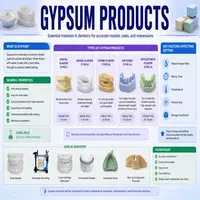
The American Dental Association classifies gypsum products into five types. Each type differs in strength, expansion, and particle shape. Consequently, each one suits a specific clinical purpose.
| Type | Name | Common Use | Setting Expansion |
|---|---|---|---|
| Type I | Impression Plaster | Rarely used impression material | Low |
| Type II | Model Plaster | Study models, mounting casts | Low |
| Type III | Dental Stone | Working casts, denture models | Moderate |
| Type IV | Die Stone | Crown and bridge dies | Very low |
| Type V | High-Strength Stone | Implant work, high-precision dies | Slightly higher than Type IV |
As shown above, Type IV is the strongest and most precise. Meanwhile, Type II is the softest and cheapest. Because of this range, technicians choose the type based on the final application.
Composition and Chemistry
All gypsum products share the same base chemical, calcium sulfate. However, the manufacturing process changes the particle shape and porosity. For instance, model plaster particles are irregular and porous. In contrast, die stone particles are dense and regular.
This difference explains why die stone needs less water to mix. Less water means fewer pores. Fewer pores mean a stronger, harder cast. Similarly, this is why die stone is chosen for crown and bridge work, where precision is critical.
The Setting Reaction Explained
Understanding the setting reaction helps technicians avoid mistakes. Below is a simple flow of what happens after mixing.
Powder + Water
      ↓
Mixing (creates a paste)
      ↓
Nucleation (crystal seeds form)
      ↓
Crystal Growth (needle-like crystals interlock)
      ↓
Setting Expansion (slight, controlled)
      ↓
Final Set (hard, rigid model)
First, the powder and water combine to form a workable paste. Next, tiny crystals begin to form within the mixture. Then, these crystals grow and interlock with one another. Finally, the mass hardens into a rigid, dimensionally stable model.
Notably, this whole reaction is exothermic, meaning it releases heat. So, if you touch a setting cast, it will feel slightly warm.
Properties That Matter
Several properties determine how well a gypsum product performs. These include setting time, setting expansion, strength, and surface hardness.
- Setting time: This is the period from mixing to the point where the cast can be handled safely.
- Setting expansion: A small, controlled increase in volume during crystallization.
- Compressive strength: How much pressure the set cast can withstand before breaking.
- Surface hardness: How resistant the surface is to scratching or abrasion.
Importantly, water-to-powder ratio affects all four properties. A higher ratio, for example, weakens the final cast. On the other hand, a lower ratio increases strength but shortens working time. Therefore, technicians must follow manufacturer instructions carefully.
Common Uses in Dental Practice
Gypsum products serve many roles across dental treatment. Below is a quick summary of typical applications.
| Application | Preferred Gypsum Type |
|---|---|
| Diagnostic study models | Type II or III |
| Orthodontic records | Type III |
| Denture construction | Type III |
| Crown and bridge dies | Type IV |
| Implant-supported prosthetics | Type V |
Furthermore, gypsum is used to mount casts on articulators. This allows dentists to study how the upper and lower teeth meet. Also, gypsum flasks are sometimes used in denture processing, though these are being replaced by newer materials.
Storage and Handling Tips
Proper storage keeps gypsum products effective for longer. Moisture is the biggest enemy here, since it triggers premature setting. Consequently, powders should always be kept in sealed, airtight containers.
In addition, storage areas should stay cool and dry. Humidity above normal levels can ruin an entire batch. Likewise, powder should never be scooped with wet tools. Even small amounts of water can cause clumping.
Before mixing, always fluff the powder gently. This step prevents lumps and ensures accurate weighing. Afterward, use a clean, dry spatula and bowl for every new mix.
Conclusion
Gypsum products remain a cornerstone of restorative and prosthetic dentistry. From simple study models to precise crown dies, they offer accuracy, affordability, and reliability. Understanding the five types helps clinicians and technicians choose the right material for each task.
Moreover, knowing the setting reaction and key properties prevents costly errors in the lab. With correct storage and handling, these materials continue to deliver consistent, dependable results. Ultimately, mastering gypsum products is a small step that leads to better, more predictable dental outcomes.
Frequently Asked Questions
1. What are gypsum products used for in dentistry? They are used to create study models, working casts, dies, and orthodontic records. Essentially, they reproduce the exact shape of a patient’s oral structures outside the mouth.
2. Which type of gypsum product is strongest? Type IV die stone is generally the strongest and most precise. Because of its low porosity, it resists chipping and distortion better than other types.
3. Why does gypsum expand while setting? Setting expansion happens due to the outward push of interlocking crystals during crystallization. Manufacturers control this expansion so it stays within a safe, predictable range.
They are used to create study models, working casts, dies, and orthodontic records. Essentially, they reproduce the exact shape of a patient’s oral structures outside the mouth.
Type IV die stone is generally the strongest and most precise. Because of its low porosity, it resists chipping and distortion better than other types.
Setting expansion happens due to the outward push of interlocking crystals during crystallization. Manufacturers control this expansion so it stays within a safe, predictable range.
It should be kept in a sealed container, away from moisture and humidity. Otherwise, the powder can absorb water and set improperly before use.
Plaster has irregular, porous particles and lower strength. Dental stone, however, has denser particles, requires less water, and produces a stronger, more accurate cast.