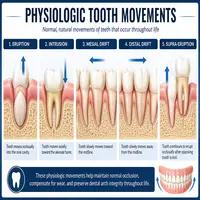
Physiologic Tooth Movements: A Complete Oral Biology Guide
Teeth look fixed in place, but they’re actually never completely still. Small, natural shifts happen throughout life, guiding teeth into position and keeping them functional.
These natural shifts fall under a concept called physiologic tooth movements. Unlike orthodontic movement, which uses external force, these movements happen as part of normal growth and function.
This guide walks through the types, mechanisms, and clinical relevance of this process. You’ll also find a comparison table and a simple flowchart to make the concept easier to visualize.
What Are Physiologic Tooth Movements?
Physiologic tooth movements refer to the natural, gradual shifts teeth make throughout a person’s lifetime. These movements occur without any external orthodontic appliance involved.
Several biological processes drive this movement. Bone remodeling, periodontal ligament changes, and eruption forces all play a part. Together, they allow teeth to adjust position gradually, supporting proper occlusion and function.
Interestingly, this process starts even before a tooth fully erupts. As a tooth develops, it moves through the jawbone before finally breaking through the gum tissue. Afterward, movement continues at a much slower pace throughout adulthood.
Understanding physiologic tooth movements helps explain why teeth can drift over time, especially after tooth loss or changes in bite pressure.
Types of Physiologic Tooth Movements
| Type | When It Occurs | Main Purpose |
|---|---|---|
| Eruptive movement | Before and during tooth eruption | Brings tooth into the oral cavity |
| Post-eruptive movement | After the tooth reaches occlusion | Maintains proper alignment and contact |
| Mesial drift | Throughout adulthood | Compensates for proximal tooth wear |
| Movements of accommodation | Ongoing, in response to jaw growth | Adjusts tooth position as jaws grow |
Eruptive Tooth Movement Explained
Eruptive movement covers everything that happens before a tooth appears in the mouth. First, the tooth forms within the jawbone, surrounded by a bony crypt. Then, it gradually moves toward the surface.
This process requires bone resorption ahead of the erupting tooth and bone deposition behind it. As a result, the tooth essentially “tunnels” through bone until it reaches the oral cavity.
Once the tooth breaks through the gum tissue, eruptive movement continues until it reaches the opposing tooth in the dental arch. At this point, occlusal contact establishes, and the tooth technically reaches functional position.
Timing varies between tooth types. Incisors typically erupt earlier, while molars, especially third molars, often erupt much later, sometimes causing crowding or impaction issues.
Post-Eruptive Tooth Movement
Once a tooth reaches occlusion, movement doesn’t simply stop. Post-eruptive movement continues to fine-tune tooth position throughout life, compensating for growth, wear, and changing jaw dimensions.
Vertical movement, for instance, compensates for tooth wear at the biting surface. As enamel gradually wears down from chewing, the tooth continues to erupt slightly, maintaining proper occlusal contact with opposing teeth.
Additionally, teeth naturally move to accommodate growth of the jaws during childhood and adolescence. This accommodation ensures the dental arch keeps pace with the expanding jawbone structure.
Physiologic tooth movements during this stage rely heavily on the periodontal ligament, a connective tissue structure that allows slight tooth mobility while still anchoring it firmly within the socket.
Physiologic Tooth Movement Flowchart
        Tooth forms within jawbone
                |
                v
       Eruptive movement begins
                |
                v
   Tooth moves through bone toward surface
                |
                v
      Tooth erupts into oral cavity
                |
                v
     Reaches occlusal contact with opposing tooth
                |
                v
       Post-eruptive movement begins
                |
                v
   Ongoing adjustments (wear, drift, jaw growth)
This continuous cycle shows how movement never fully stops, even long after a tooth first appears.
Mesial Drift and the Periodontal Ligament
Mesial drift describes the gradual forward movement of teeth toward the front of the dental arch. This movement helps compensate for enamel loss between adjacent teeth caused by normal chewing forces over time.
The periodontal ligament plays a central role here. It contains collagen fibers, blood vessels, and nerve endings, all of which respond to pressure and allow controlled tooth movement without damaging surrounding bone.
Occlusal forces from chewing also contribute to mesial drift. Since most people chew with a forward-directed force pattern, teeth slowly shift in that same direction across decades.
Because of mesial drift, physiologic tooth movements can sometimes cause noticeable changes in dental alignment later in life, even without any orthodontic treatment. Dentists often observe this shift during routine long-term checkups.
Clinical Importance of Physiologic Tooth Movements
Understanding this process helps explain several everyday dental observations. For example, tooth drifting after extraction happens because neighboring teeth shift into the empty space over time.
Similarly, this concept explains why missing teeth, if left untreated, can lead to bite misalignment. Adjacent and opposing teeth often move into the gap, disrupting overall occlusal balance.
Orthodontists also rely on this knowledge when planning treatment. Since physiologic movement happens naturally, understanding its patterns helps predict how teeth might respond to applied orthodontic forces.
Furthermore, dentists use this knowledge to explain age-related changes to patients, helping them understand why their bite or alignment might shift slightly, even without any obvious cause.
Conclusion
Physiologic tooth movements happen quietly, often without anyone noticing until changes become visible. From the earliest eruptive shifts to mesial drift decades later, teeth remain in constant, gradual motion.
This process supports proper function, compensates for wear, and adjusts to jaw growth throughout life. Recognizing these movements helps explain common dental changes, from post-extraction drifting to bite shifts with age.
Ultimately, this natural process highlights just how dynamic the mouth really is, proving that teeth are far from static structures, even when they appear perfectly still.
Frequently Asked Questions
They are natural tooth movements that occur without external orthodontic force, including eruption, post-eruptive adjustment, and mesial drift.
Eruptive movement brings the tooth into the mouth, while post-eruptive movement continues afterward to maintain proper occlusion and alignment.
Chewing forces and gradual enamel wear between adjacent teeth cause mesial drift, shifting teeth slightly forward over time.
Neighboring teeth naturally drift into the empty space, an example of physiologic tooth movement responding to a changed environment.
No. While movement slows significantly in adulthood, teeth continue adjusting slightly throughout life in response to wear and function.