The Larynx Explained: Structure, Function & Health
Your throat holds one of the most underrated structures in the human body. It lets you breathe, swallow, and speak, often without a single thought. This small organ sits quietly at work every day, yet most people never learn how it truly functions.
This guide breaks everything down in plain language. You will learn where this structure sits, what it is made of, and why it deserves more attention. Along the way, you will find a simple table, an easy flowchart, and answers to common questions.
So, let’s take a closer look at this fascinating part of your anatomy.
What Sits Behind Your Throat?
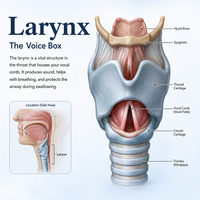
The larynx is a short, tube-shaped organ located in the neck. It connects the throat to the windpipe. Doctors often call it the voice box because it produces sound.
This structure protects the airway during swallowing. Meanwhile, it also allows air to pass freely during breathing. Therefore, it plays two critical roles at once: protection and airflow.
Most adults can feel this organ by touching the front of their neck. That bump you notice is commonly known as the Adam’s apple. It belongs to a piece of cartilage that shields the delicate tissue underneath.
Interestingly, this organ sits higher in children than in adults. As a person ages, the structure gradually shifts lower in the neck. This shift explains why voices deepen during puberty.
The Building Blocks: Cartilage, Muscle, and Tissue
Several parts work together to keep this organ functioning smoothly. Cartilage forms the outer framework, while muscles control movement inside. Mucous membranes line the interior and keep tissues moist.
Nine cartilages make up the main framework. Three are large and unpaired, while six form matching pairs. Each piece plays a specific role in shaping sound and protecting the airway.
The table below summarizes the main cartilages and their functions.
| Cartilage Name | Type | Main Function |
|---|---|---|
| Thyroid cartilage | Unpaired | Forms the Adam’s apple; shields the front |
| Cricoid cartilage | Unpaired | Supports the structure like a ring |
| Epiglottis | Unpaired | Closes over the airway during swallowing |
| Arytenoid cartilages | Paired | Move vocal folds for sound production |
| Corniculate cartilages | Paired | Add support to arytenoid movement |
| Cuneiform cartilages | Paired | Strengthen the folds near the epiglottis |
Notably, the vocal folds sit between the thyroid and arytenoid cartilages. These folds vibrate as air passes through them. As a result, sound waves form and travel out through the mouth.
How Sound and Breath Travel Through This Organ
Understanding the process becomes easier with a simple flow. Below is a basic flowchart showing how air moves through this structure during speech.
Lungs
  │
  ▼
Trachea (windpipe)
  │
  ▼
Voice box (vocal folds vibrate)
  │
  ▼
Pharynx (throat)
  │
  ▼
Mouth or Nasal Cavity
  │
  ▼
Sound Released
First, air leaves the lungs and travels upward. Next, it passes through the trachea toward the throat region. Then, the vocal folds vibrate as air pushes past them. Afterward, sound waves move through the pharynx and exit through the mouth.
This entire sequence happens in a fraction of a second. Consequently, speech feels instant and effortless for most healthy individuals.
Why This Structure Matters for Daily Life
This organ supports three essential tasks every single day. First, it protects the lungs from food and liquid. Second, it produces the sounds needed for speech and singing. Third, it helps regulate airflow during physical activity.
Without a functioning larynx, swallowing becomes dangerous. Food or liquid could easily slip into the lungs instead of the stomach. Thankfully, the epiglottis closes automatically to prevent this from happening.
Singers and public speakers rely heavily on this structure too. Vocal folds stretch and tighten to change pitch. Similarly, they relax to produce lower, deeper tones.
Coughing also depends on this organ closing tightly. This closure builds pressure before a forceful release clears the airway. In other words, this small structure supports survival, communication, and protection all at once.
Common Problems That Affect This Organ
Several conditions can disrupt normal function over time. Laryngitis causes swelling and hoarseness, often from infection or overuse. Vocal cord nodules develop from repeated strain, especially in singers and teachers.
Acid reflux frequently irritates the sensitive lining as well. Over time, this irritation may lead to chronic hoarseness or a persistent cough. Smoking damages tissue too, increasing the risk of long-term complications.
In rarer cases, growths or tumors can form within this region. Early diagnosis remains important, so persistent hoarseness should never be ignored. A doctor can examine the area using a small camera called a laryngoscope.
Tips for Keeping This Organ Healthy
Simple habits protect this structure for years to come. Staying hydrated keeps vocal folds flexible and reduces strain. Avoiding excessive shouting also prevents unnecessary damage.
Additionally, limiting smoking and alcohol supports healthier tissue overall. Warming up your voice before singing or public speaking helps too. Meanwhile, resting your voice after illness allows proper healing.
Doctors also recommend treating acid reflux early. Untreated reflux often leads to ongoing irritation and discomfort. Overall, small daily choices make a noticeable difference over time.
Conclusion
The larynx may be small, yet its impact on daily life is enormous. It protects your airway, shapes your voice, and supports countless daily functions without pause. From childhood through old age, this structure adapts and continues working reliably.
Understanding its parts and functions helps you appreciate a system you rarely think about. Simple habits, like staying hydrated and resting your voice, go a long way toward long-term health. Ultimately, a little awareness today can prevent bigger problems tomorrow.
Frequently Asked Questions
It sits in the neck, between the throat and the windpipe. You can often feel it by touching the front of your throat.
It protects the airway, produces sound, and helps regulate breathing. These three roles work together every day.
Cartilage grows larger, and vocal folds lengthen during this stage. As a result, the voice typically deepens, especially in boys.
Minor irritation often improves with rest and hydration. However, persistent symptoms should always be checked by a doctor.
An otolaryngologist, also known as an ENT specialist, handles these conditions. They diagnose and treat issues affecting the throat and voice box.