History of Community Dentistry
Dental care wasn’t always about individual checkups and private clinics. Long before dentistry became a personal, one-on-one service, communities worked together to manage oral health at a population level. The history of community dentistry reveals how societies gradually shifted from treating isolated tooth problems to preventing disease across entire populations through education, policy, and public health programs.
In this article, we will trace the evolution of community dentistry from its earliest roots to its modern form. Additionally, we will look at major milestones, key figures, and the lasting impact this field has had on public health systems around the world.
Early Origins of Community Dentistry
Community dentistry did not appear overnight. Instead, it developed gradually as societies began recognizing that oral disease affected entire populations, not just individual patients. Ancient civilizations, including the Egyptians and Greeks, documented basic dental remedies, yet these efforts remained largely individual rather than community-based.
Furthermore, early public health movements in the 18th and 19th centuries began linking overall hygiene with disease prevention. As a result, dental problems started being viewed through a broader public health lens rather than purely as personal ailments. Meanwhile, industrialization brought overcrowded cities, poor nutrition, and rising sugar consumption, all of which contributed to widespread tooth decay among the working class.
Governments and reformers eventually realized that treating individuals one at a time could not solve a problem affecting millions. However, this realization took decades to translate into organized action. Consequently, the late 19th century became a turning point, setting the stage for the first true community-based dental health programs.
The Birth of Organized Dental Public Health
The late 1800s and early 1900s marked a major shift toward organized dental public health efforts. For instance, school-based dental inspection programs began appearing in parts of Europe and North America, aiming to catch problems early among children. The table below highlights some key milestones from this formative period.
| Year | Milestone | Region |
|---|---|---|
| 1884 | First school dental clinic established | Strasbourg, Germany |
| 1901 | School dental inspections introduced | United Kingdom |
| 1910 | Dental hygiene taught in public schools | United States |
| 1945 | Community water fluoridation trials begin | United States |
| 1960s | WHO promotes global oral health initiatives | Worldwide |
These early programs focused heavily on children, since school settings offered an efficient way to reach large populations. On the other hand, adult oral health remained largely neglected during this period, often addressed only through private dental visits. Similarly, dental education for the public was minimal, leaving most preventive knowledge concentrated among professionals rather than communities themselves.
Notably, water fluoridation became one of the most influential public health measures in dental history. Some cities, like Grand Rapids in Michigan, became famous test cases for fluoridation. Some cities, like others across the United States, quickly followed once results showed reduced tooth decay rates. Therefore, this single intervention reshaped how governments approached preventive dentistry on a mass scale.
Growth Through the 20th Century
As the 20th century progressed, community dentistry expanded well beyond school programs and fluoridation. In addition, governments began establishing dedicated public health dentistry departments to coordinate efforts more effectively.
For example, many countries introduced subsidized dental care for low-income families, recognizing that cost remained a major barrier to treatment. Meanwhile, dental health education expanded into mass media, with campaigns promoting toothbrushing, reduced sugar intake, and regular checkups. As a result, public awareness of preventive oral care grew significantly compared to earlier decades.
International organizations also played a growing role during this period. The World Health Organization began coordinating global oral health initiatives, helping developing nations build their own public dental health infrastructure. Similarly, dental schools started incorporating community dentistry as a formal subject, training future dentists to think beyond individual patients toward population-level health outcomes. Consequently, community dentistry evolved from a scattered set of local efforts into a recognized, structured discipline within dental education.
Key Milestones Timeline
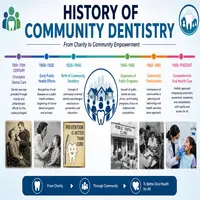
Understanding how community dentistry developed becomes easier when viewed as a timeline. The flowchart below outlines the major phases this field has passed through over time.
START
  │
  ▼
Ancient Remedies (individual treatment only)
  │
  ▼
Industrial Era Awareness (linking hygiene to disease)
  │
  ▼
School Dental Programs (early 1900s)
  │
  ▼
Water Fluoridation Era (1940s onward)
  │
  ▼
Global Public Health Integration (WHO involvement)
  │
  ▼
Modern Community Dentistry (policy, education, access programs)
  │
  ▼
END
First, ancient societies treated dental issues on a purely individual basis, with no organized public strategy. Then, industrialization forced a rethinking of hygiene and disease at a societal level. Afterward, school-based programs introduced the first structured, population-focused dental efforts.
Subsequently, fluoridation transformed prevention into a mass, community-wide intervention rather than something left to individual choice. Eventually, global organizations helped standardize and spread these practices internationally. This progression, though gradual, ultimately built the foundation for the comprehensive community dentistry systems used today.
Community Dentistry in the Modern Era
Today, community dentistry looks vastly different from its early beginnings. Modern programs focus on accessibility, education, and prevention through coordinated public health policy rather than isolated interventions. In fact, many countries now integrate dental care into broader primary healthcare systems, ensuring oral health isn’t treated as separate from overall wellbeing.
Technology has also reshaped this field significantly. Similarly, mobile dental clinics now reach rural and underserved populations that previously had little access to care. Meanwhile, digital health records and tele-dentistry allow professionals to monitor community health trends more efficiently than ever before.
Ultimately, the lessons learned throughout the history of community dentistry continue shaping policy decisions today. Nevertheless, challenges like unequal access and funding gaps remain, proving that this field’s evolution is far from finished.
Conclusion
The history of community dentistry shows a clear progression from isolated individual treatment to organized, population-wide prevention strategies. From ancient remedies to school programs, fluoridation, and global health initiatives, each milestone built upon the last to create the comprehensive systems we rely on today. Understanding this journey helps explain why modern dental public health looks the way it does.
As healthcare continues evolving, the principles behind community dentistry remain more relevant than ever. Therefore, whether you’re a dental student, a public health professional, or simply curious about how oral healthcare became a societal priority, exploring this history offers valuable perspective on the ongoing effort to protect smiles at every level of society.
Frequently Asked Questions
Community dentistry is a branch of dental science focused on preventing and controlling oral disease at a population level through education, policy, and public health programs rather than individual treatment alone.
Organized efforts began gaining momentum in the late 1800s, with school dental clinics and inspections marking some of the earliest structured community-based programs.
Water fluoridation allowed entire communities to benefit from cavity prevention automatically, without relying on individual behavior, making it one of the most impactful public health measures in dental history.
The WHO helped standardize oral health initiatives globally, supporting developing nations in building public dental health infrastructure and promoting preventive care worldwide.
Modern community dentistry includes mobile clinics, tele-dentistry, school programs, and integration with primary healthcare systems to improve access and prevention across diverse populations