Intro to Biostatistics in Dental Public Health
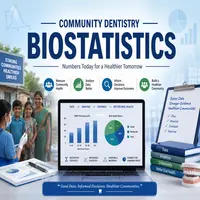
Community dentistry depends on numbers. Every prevention program, every survey, and every policy decision needs solid data behind it. This is where the intro to biostatistics in dental public health becomes essential. Biostatistics helps dental teams measure disease patterns, test treatments, and plan better oral health programs. For example, a city health department might track cavity rates across schools. However, raw numbers alone tell us little. Therefore, dental professionals use statistical tools to turn data into clear, actionable insights. This guide breaks down the basics in simple terms, so students, clinicians, and public health workers can follow along easily.
What Is Biostatistics in Dental Public Health?
Biostatistics is the branch of statistics applied to health and biological data. In dentistry, it focuses on oral health trends across populations. Consequently, it supports decisions about fluoride programs, screening schedules, and resource allocation. Dental public health teams collect data from clinics, schools, and community surveys. Then, they analyze this data to find patterns.
For instance, researchers might compare tooth decay rates between two neighborhoods. Similarly, they might track gum disease trends over several years. As a result, health departments can target resources where they are needed most. Without biostatistics, these decisions would rely on guesswork instead of evidence.
Additionally, biostatistics supports research validity. It helps researchers avoid false conclusions. In short, it turns scattered numbers into a story that guides real-world action.
Why Community Dentistry Needs Biostatistics
Community dentistry serves large groups, not just individual patients. Therefore, decisions must apply to entire populations. This requires accurate, population-level data. Biostatistics provides the tools to gather and interpret that data correctly.
Consider a school-based sealant program. Health officials need to know how many children benefit. They also need to know if the program reduces cavities significantly. Biostatistics answers both questions through structured analysis.
Moreover, public health budgets are limited. Officials must justify spending with solid evidence. As a result, biostatistical analysis becomes a core part of grant applications and policy reports. Without it, funding decisions would lack credibility.
Finally, biostatistics supports fairness. It helps identify which communities face the greatest oral health disparities. Consequently, resources reach the populations that need them most.
Core Concepts Every Dental Public Health Worker Should Know
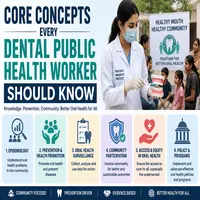
Understanding a few key terms makes biostatistics much easier to apply. The table below summarizes common concepts used in dental research.
| Concept | Simple Explanation | Example in Dentistry |
|---|---|---|
| Population | The full group being studied | All children in a school district |
| Sample | A smaller group representing the population | 200 randomly selected students |
| Mean | The average value | Average number of cavities per child |
| Prevalence | Percentage of a population with a condition | 25% of adults have gum disease |
| Incidence | New cases over a specific time | New cavity cases per year |
| Confidence Interval | Range likely to contain the true value | 95% CI for decay rate |
| P-value | Probability the result happened by chance | p < 0.05 shows significance |
These terms form the foundation of dental research. Once mastered, they make reading studies far easier. In addition, they help dental teams design their own surveys correctly.
Steps in a Dental Public Health Study
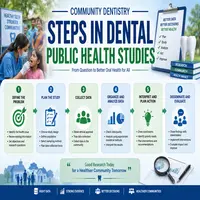
Every community dental study follows a similar process. The flowchart below outlines the typical steps.
Step 1: Define the Research Question
        ↓
Step 2: Choose the Population and Sample
        ↓
Step 3: Collect Oral Health Data
        ↓
Step 4: Apply Statistical Tests
        ↓
Step 5: Interpret Results
        ↓
Step 6: Share Findings with Stakeholders
First, researchers define a clear question, such as “Does water fluoridation reduce cavities?” Next, they select a representative sample. Then, they collect data through exams, surveys, or clinical records.
After that, statisticians apply the right tests to the data. Subsequently, they interpret the results in context. Finally, they present findings to policymakers, schools, or health boards. This structured approach keeps research reliable and easy to repeat.
Common Statistical Tests Used in Dental Research
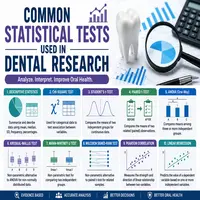
Different research questions require different tests. The table below highlights common methods used in an intro to biostatistics in dental public health course.
| Test | Purpose | Dental Example |
|---|---|---|
| Chi-square test | Compares categories | Decay rates between two age groups |
| T-test | Compares two averages | Plaque scores before and after treatment |
| ANOVA | Compares three or more groups | Cavity rates across multiple schools |
| Regression | Studies relationships between variables | Sugar intake and cavity risk |
| Correlation | Measures how two variables move together | Brushing frequency and gum health |
Each test suits a specific type of question. For example, a chi-square test works well for yes-or-no outcomes. Meanwhile, regression suits questions involving multiple risk factors. Choosing the right test improves accuracy and avoids misleading conclusions.
Challenges in Applying Biostatistics to Dental Public Health
Despite its value, biostatistics comes with challenges. Data collection can be inconsistent across clinics. Also, sample sizes are sometimes too small for reliable results. In addition, dental teams may lack formal statistical training.
However, simple software tools now make analysis more accessible. Many public health departments use basic statistical programs instead of complex systems. As a result, smaller clinics can still produce meaningful reports.
Furthermore, training programs increasingly include an intro to biostatistics in dental public health as a core module. This helps future dentists and hygienists build confidence with data early in their careers.
Conclusion
Biostatistics plays a central role in modern community dentistry. It shapes how health departments plan programs, allocate funding, and measure success. An intro to biostatistics in dental public health gives dental professionals the tools to read research critically and apply it locally. From simple averages to advanced regression models, each method serves a clear purpose. As oral health data grows more complex, these skills will only become more valuable. Dental teams that understand biostatistics can turn raw numbers into real community impact.
Frequently Asked Questions
Biostatistics in dental public health is the use of statistical methods to study oral health patterns across populations. It helps guide prevention programs and policy decisions.
It provides evidence-based support for decisions. Consequently, health departments can target the right communities with the right resources.
Common tests include chi-square tests, t-tests, ANOVA, regression, and correlation analysis. Each test fits different types of research questions.
Yes. Many training programs now include an intro to biostatistics in dental public health, since hygienists often assist with community screenings and reports.
It measures program effectiveness clearly. As a result, health officials can adjust strategies based on real outcomes rather than assumptions.