Meninges and CSF in Brain: A Complete Anatomy Guide
The brain is soft, delicate, and constantly active. Because of this, nature built two protective systems around it. These systems are the meninges and CSF in brain tissue. Together, they shield the central nervous system from injury and infection. Additionally, they maintain a stable environment for neurons to function properly.
In this guide, we explore both structures in detail. We look at their layers, roles, and daily importance. Furthermore, we explain how they interact to keep the brain safe. By the end, you will understand why these two systems matter so much for human health.
What Are the Meninges?
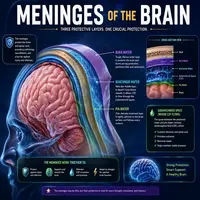
The meninges are three connective tissue layers. They wrap around the brain and spinal cord completely. Each layer has a distinct texture and job. Consequently, doctors study them separately during diagnosis.
Firstly, the outer layer is called the dura mater. It is thick, tough, and fibrous in nature. Secondly, the middle layer is the arachnoid mater. It looks like a spider’s web, which explains its name. Thirdly, the inner layer is the pia mater. It clings tightly to the brain’s surface.
These three layers do not simply sit still. Instead, they actively support blood vessels and nerve pathways. Moreover, they create small spaces where fluid can circulate. This fluid plays a major role in protection, and we discuss it next.
Layers of the Meninges Explained
Each meningeal layer serves a unique purpose. Understanding these differences helps clarify how the brain stays protected. The table below summarizes the key features of each layer.
| Layer | Location | Texture | Main Function |
|---|---|---|---|
| Dura Mater | Outermost | Thick and tough | Provides structural protection |
| Arachnoid Mater | Middle | Web-like and thin | Holds cerebrospinal fluid space |
| Pia Mater | Innermost | Delicate and vascular | Nourishes brain tissue directly |
Between the arachnoid and pia layers lies the subarachnoid space. This space holds most of the cerebrospinal fluid. Therefore, it acts as a cushion during sudden head movements. Without this space, minor bumps could cause serious brain damage.
In short, the meninges and CSF in brain anatomy work as one connected system. Neither structure functions well without the other nearby.
What Is Cerebrospinal Fluid (CSF)?

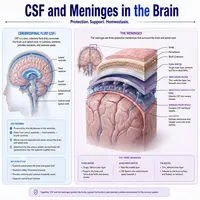
Cerebrospinal fluid, commonly called CSF, is a clear liquid. It surrounds the brain and spinal cord at all times. Specialized tissue called the choroid plexus produces this fluid continuously. As a result, the body maintains a fresh, steady supply.
CSF is not just simple water. Instead, it contains proteins, glucose, and essential ions. These components support neuron health and communication. Additionally, CSF removes waste products from brain tissue efficiently.
On average, the human body holds about 150 milliliters of CSF. However, the body produces roughly 500 milliliters daily. This means the fluid gets replaced several times each day. Such constant renewal keeps the brain environment clean and stable.
Functions of CSF in the Brain

CSF performs several critical jobs at once. First, it cushions the brain against sudden impacts. Second, it removes metabolic waste through natural drainage pathways. Third, it helps regulate intracranial pressure levels.
Furthermore, CSF supports buoyancy for the brain itself. The brain effectively floats within this fluid layer. Consequently, its actual weight decreases significantly inside the skull. This reduces pressure on blood vessels and nerve roots below.
CSF also transports hormones and nutrients efficiently. Meanwhile, it carries away carbon dioxide and cellular debris. Because of these combined roles, doctors often test CSF samples. Abnormal results can reveal infections, bleeding, or other neurological issues quickly.
Below is a quick summary of CSF functions:
| Function | Benefit to the Brain |
|---|---|
| Shock absorption | Reduces impact from sudden movement |
| Waste removal | Clears metabolic byproducts |
| Pressure regulation | Maintains stable intracranial pressure |
| Nutrient transport | Delivers glucose and proteins |
| Buoyancy support | Lowers effective brain weight |
How CSF Flows Through the Brain

CSF does not remain still after production. Rather, it flows through a specific pathway continuously. This circulation ensures fresh fluid reaches every brain region. The flowchart below outlines this process step by step.
CSF Flow Pathway:
Choroid Plexus (Production)
        ↓
Lateral Ventricles
        ↓
Third Ventricle
        ↓
Cerebral Aqueduct
        ↓
Fourth Ventricle
        ↓
Subarachnoid Space
        ↓
Reabsorption into Bloodstream
At each stage, CSF interacts closely with surrounding meningeal tissue. Blockages anywhere along this path can cause serious conditions. For example, hydrocephalus develops when fluid cannot drain properly. Therefore, understanding this flow helps explain many neurological disorders.
Meninges and CSF Working Together
The meninges and CSF in brain protection do not act alone. Instead, they form an integrated defense system. The meninges provide physical structure and containment. Meanwhile, CSF provides cushioning and biochemical balance within that structure.
This partnership matters most during trauma. When the head experiences impact, CSF absorbs shock immediately. Simultaneously, the meninges prevent the brain from shifting too far. Together, these mechanisms limit damage significantly during accidents or falls.
Infections also highlight this relationship clearly. Meningitis, for instance, involves inflammation of the meninges. However, it often affects CSF composition too. Doctors frequently test CSF samples to diagnose meningitis accurately and quickly.
Conclusion
The meninges and CSF in brain anatomy form one of the body’s most elegant protective systems. The three meningeal layers offer structural defense, while CSF adds cushioning, nutrition, and waste removal. Neither system works effectively without the other supporting it.
Understanding this relationship helps explain many neurological conditions, from meningitis to hydrocephalus. It also highlights why brain injuries can become so serious when this protection fails. Ultimately, appreciating these structures gives us greater respect for the brain’s remarkable natural design.
Frequently Asked Questions
The meninges protect the brain and spinal cord physically. They also anchor blood vessels and support CSF circulation.
The choroid plexus produces CSF continuously inside the brain’s ventricles. The body then circulates and reabsorbs this fluid daily.
Blocked CSF flow can cause hydrocephalus, a condition involving fluid buildup. This buildup increases pressure inside the skull dangerously.
The meninges have three layers total. These include the dura mater, arachnoid mater, and pia mater.
Doctors test CSF to detect infections, bleeding, or inflammation. Abnormal CSF results often indicate serious neurological conditions.