Endodontic Microbiology: The Bacterial Story Behind Root Canal Infections
Root canal infections rarely happen by accident. Behind almost every case lies a complex community of bacteria that invades the tooth, multiplies within the pulp space, and eventually threatens the surrounding bone. Studying these microorganisms helps clinicians understand why infections persist, why some resist treatment, and why thorough disinfection remains essential during endodontic therapy.
This article explores the field of endodontic microbiology, covering the bacterial species involved, how they invade the tooth, and how they organize into resistant communities. Along the way, you will find tables, a flowchart, and a concept map to make these concepts easier to follow. By the end, you will understand why microbiology sits at the core of modern endodontic practice.
What Is Endodontic Microbiology?
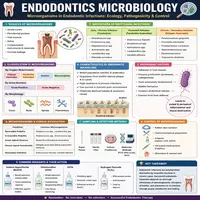
Endodontic microbiology is the study of microorganisms that colonize the root canal system and contribute to pulp and periapical disease. Rather than involving a single bacterial species, most infections consist of complex, mixed communities that interact with one another and with the host’s immune response. This complexity explains why root canal infections often behave differently from simple, single-organism infections elsewhere in the body.
Because the pulp chamber is normally sterile, bacteria must actively invade through cracks, deep caries, or exposed dentinal tubules to establish infection. Once inside, they encounter a low-oxygen environment that favors anaerobic bacteria over the aerobic species commonly found in the mouth. Consequently, the microbial population inside an infected root canal looks quite different from the bacteria found on tooth surfaces or in saliva.
Understanding this shift matters clinically, since treatment strategies must target the specific organisms likely to thrive within this unique environment. Without this knowledge, disinfection protocols would be far less effective at eliminating the true source of infection.
Key Bacterial Species in Root Canal Infections
Certain bacterial species appear repeatedly in infected root canals, and researchers have identified their roles through extensive culturing and molecular studies. The table below summarizes several commonly implicated organisms.
| Bacterial Species | Type | Clinical Significance |
|---|---|---|
| Enterococcus faecalis | Facultative anaerobe | Frequently found in persistent or failed root canal treatments |
| Porphyromonas gingivalis | Obligate anaerobe | Associated with periapical abscess formation |
| Fusobacterium nucleatum | Obligate anaerobe | Acts as a bridging organism in mixed biofilms |
| Prevotella intermedia | Obligate anaerobe | Linked to acute infection and pain |
| Streptococcus species | Facultative anaerobe | Common early colonizers of exposed pulp tissue |
Interestingly, Enterococcus faecalis deserves particular attention because of its resilience. This organism can survive in nutrient-poor environments, resist common intracanal medications, and persist even after seemingly thorough treatment. As a result, it remains one of the most frequently studied bacteria in cases of treatment failure.
How Bacteria Invade the Root Canal System
Bacterial invasion typically follows a predictable route, beginning outside the tooth and progressing inward until it reaches the pulp and periapical tissues. Recognizing this pathway helps explain why untreated decay so often leads to root canal infection over time.
- Initial entry: Bacteria penetrate through carious lesions, cracks, or exposed dentinal tubules following trauma.
- Pulp colonization: Once inside, bacteria multiply within the confined pulp chamber, triggering inflammation and eventual tissue breakdown.
- Canal system spread: Microorganisms travel through the main canal and into smaller lateral canals, accessory canals, and dentinal tubules.
- Periapical extension: Bacteria and their toxins eventually exit through the apical foramen, provoking an immune response in the surrounding bone.
At each stage, bacteria adapt to increasingly hostile, low-oxygen conditions. Therefore, the microbial population shifts from a mixed aerobic-anaerobic community near the tooth surface to a predominantly anaerobic one deep within the canal system.
Biofilm Formation: A Simple Flowchart
Bacteria inside the root canal rarely exist as free-floating organisms. Instead, they organize into structured communities called biofilms, which offer significant protection against the host immune system and antimicrobial treatment. The flowchart below outlines this process.
Bacteria Enter the Root Canal System
        │
        ▼
Initial Attachment to Dentin or Necrotic Pulp Tissue
        │
        ▼
Microcolonies Form and Begin Producing Extracellular Matrix
        │
        ▼
Matrix Encases Bacteria, Creating a Protective Biofilm Structure
        │
        ▼
Different Species Interact, Sharing Nutrients and Signals
        │
        ▼
Biofilm Matures, Becoming Highly Resistant to Disinfection
        │
        ▼
Persistent Infection Develops If Biofilm Is Not Fully Disrupted
This process explains why mechanical instrumentation alone often fails to eliminate infection completely. Because biofilm structure shields bacteria from direct contact with irrigants, endodontists must combine mechanical cleaning with chemical disinfection to achieve thorough decontamination.
Why Endodontic Microbiology Shapes Treatment Decisions
Understanding the microbial basis of root canal infection directly informs how endodontists approach treatment. Since biofilms resist simple rinsing, clinicians rely on a combination of mechanical shaping and chemical irrigation to disrupt bacterial communities effectively.
Sodium hypochlorite remains the most widely used irrigant because of its strong antibacterial properties and ability to dissolve organic tissue. Meanwhile, chlorhexidine offers substantivity, meaning it continues exerting antibacterial effects even after application. In more resistant cases, calcium hydroxide may be placed as an interappointment medication to further reduce bacterial load between visits.
Even with these tools, complete sterilization of the canal system remains difficult due to the complex anatomy involved. Consequently, the goal of treatment shifts toward significant bacterial reduction rather than absolute elimination, since a sufficiently reduced microbial population allows the body’s immune system to manage any remaining organisms.
Concept Map: Endodontic Microbiology in Context
To visualize how these elements connect, consider the concept map below.
                    ENDODONTIC MICROBIOLOGY
                            │
      ┌─────────────────────┼─────────────────────┐
      │                     │                       │
   BACTERIA              PROCESSES                TREATMENT
      │                     │                       │
Enterococcus faecalis    Invasion              Mechanical shaping
Porphyromonas gingivalis  Colonization        Chemical irrigation
Fusobacterium nucleatum   Biofilm formation   Interappointment medication
Streptococcus species    Periapical spread     Bacterial reduction goal
      │                     │                       │
      └─────────────────────┼─────────────────────┘
                            │
                  SUCCESSFUL INFECTION CONTROL
This map illustrates how bacterial identity, disease progression, and treatment strategy all connect within a single framework. Missing any one piece can compromise the effectiveness of endodontic therapy.
Persistent Infections and Treatment Failure
Despite careful treatment, some infections persist or recur after root canal therapy. Research consistently points to bacteria surviving within areas inaccessible to standard instrumentation, such as isthmuses, lateral canals, and deep dentinal tubules. Enterococcus faecalis, mentioned earlier, frequently appears in these persistent cases due to its resistance to common medications.
Additionally, extraradicular infection, where bacteria establish colonies outside the root canal system entirely, can occasionally explain treatment failure despite thorough intracanal disinfection. In such situations, surgical intervention may become necessary to address bacteria that mechanical and chemical methods cannot reach.
Ongoing research in endodontic microbiology continues to refine disinfection protocols, exploring newer irrigants, laser-assisted techniques, and improved medicaments. As diagnostic tools advance, clinicians gain a clearer picture of which organisms drive resistant infections, allowing more targeted treatment approaches.
Conclusion
Endodontic microbiology reveals that root canal infections are rarely simple, single-organism problems. Instead, they involve complex bacterial communities that invade the canal system, form resistant biofilms, and adapt to challenging low-oxygen conditions. Recognizing these dynamics explains why thorough mechanical and chemical disinfection remains central to successful treatment.
By understanding which bacteria drive infection and how they organize themselves, clinicians can make more informed decisions about irrigants, medications, and retreatment strategies. Ultimately, a solid grasp of endodontic microbiology continues to shape better outcomes for patients facing pulp and periapical disease.
Frequently Asked Questions
It focuses on identifying and understanding the bacteria that infect the root canal system, along with how they contribute to pulp and periapical disease.
This bacterium survives in nutrient-poor environments and resists many common intracanal medications, making it a frequent cause of persistent or failed root canal treatments.
A biofilm is a structured bacterial community protected by a self-produced matrix. It resists disinfection more effectively than free-floating bacteria, making infections harder to eliminate.
Complete sterilization is difficult due to complex canal anatomy. Treatment instead aims for significant bacterial reduction, allowing the immune system to manage any remaining organisms.
Bacteria can survive in areas inaccessible to standard instruments, such as lateral canals and dentinal tubules. Resistant species and, occasionally, extraradicular infection can also contribute to treatment failure.