Structures and Properties of Metals in Dental Materials Explained
Metals play a huge role in dentistry. For instance, they appear in crowns, braces, and implants. But why do some metals bend easily while others stay rigid for years? Essentially, the answer lies in their internal structure.
In this guide, we will explore this topic in a simple, friendly way. First, we will avoid heavy jargon. Instead, we will use clear explanations, useful tables, and a flowchart. By the end, you will understand why dentists choose specific metals for specific jobs.
What Do We Mean by Metal Structure?
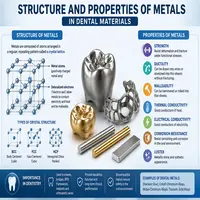
Every metal is made of tiny building blocks called atoms. Specifically, these atoms arrange themselves in repeating patterns. This arrangement is called a crystal lattice. Therefore, the structures and properties of metals depend heavily on how these atoms line up.
Most dental metals form one of three common lattice types. For example, these include face-centered cubic, body-centered cubic, and hexagonal close-packed structures. As a result, each pattern affects strength, ductility, and how the metal behaves under stress.
In addition, the way atoms bond together matters too. Specifically, metallic bonds allow electrons to move freely. As a result, metals conduct heat and electricity well. Moreover, this same bonding also gives metals their shine and flexibility.
Why Structure Affects Performance
Dentists do not choose metals randomly. Instead, they select materials based on how atoms behave inside them. Therefore, understanding the structures and properties of metals helps clinicians predict clinical success.
For example, consider a dental crown. Above all, it must resist chewing forces every single day. Generally, a metal with a strong, tightly packed structure resists deformation better. On the other hand, a looser structure may bend or crack under pressure.
Furthermore, grain size within the metal plays a role. Typically, smaller grains produce stronger metals. In contrast, larger grains can create weak points. Consequently, manufacturers control cooling rates carefully during production to manage grain size.
Key Physical Properties Dentists Care About
Next, let’s break down the properties that matter most in clinical practice.
1. Strength
First, strength refers to how much force a metal can handle before it fails. Overall, dental metals need enough strength to survive years of biting and chewing.
2. Ductility
Similarly, ductility describes how easily a metal can be shaped without breaking. For instance, wires used in orthodontics need high ductility. Otherwise, they would snap during adjustment.
3. Hardness
Meanwhile, hardness measures resistance to scratching or wear. Ideally, chewing surfaces need reasonable hardness to avoid rapid wear over time.
4. Corrosion Resistance
Also, saliva creates a harsh environment. Therefore, dental metals must resist corrosion. Otherwise, they could release harmful ions into the mouth.
Quick Reference: Metal Properties Table
| Property | Definition | Clinical Importance |
|---|---|---|
| Strength | Resistance to permanent deformation | Prevents crown or bridge failure |
| Ductility | Ability to bend without breaking | Needed for wires and clasps |
| Hardness | Resistance to surface wear | Keeps chewing surfaces intact |
| Corrosion Resistance | Resistance to chemical breakdown | Protects oral tissue from harm |
| Melting Point | Temperature at which metal liquefies | Affects casting and fabrication |
Overall, keep this table handy. Indeed, it offers a quick snapshot of what matters most.
How Metal Structure Leads to Clinical Performance: A Flowchart
Below is a simplified path. Specifically, it shows how atomic structure connects to real-world dental performance.
Atomic Arrangement (Crystal Lattice)
              |
              v
Grain Size and Bonding Pattern
              |
              v
Physical Properties (Strength, Hardness, Ductility)
              |
              v
Manufacturing Process (Casting, Alloying, Heat Treatment)
              |
              v
Final Dental Product (Crown, Bridge, Wire, Implant)
              |
              v
Clinical Performance in the Mouth
Clearly, this flow shows a straightforward chain. Moreover, each step builds on the one before it. Consequently, small changes at the atomic level can create big differences in the finished product.
Common Dental Metals and Their Traits
Next, different metals serve different purposes. So, let’s look at a few common examples used in dentistry today.
- Gold Alloys: These offer excellent corrosion resistance and good ductility. However, they cost more than other options.
- Cobalt-Chromium Alloys: These provide high strength and hardness. Therefore, dentists often use them for partial dentures.
- Titanium: This metal offers outstanding corrosion resistance and biocompatibility. As a result, it remains the top choice for dental implants.
- Stainless Steel: This metal balances strength and cost. Consequently, it appears often in orthodontic wires and bands.
Overall, each metal brings unique strengths. Ultimately, choosing the right one depends on the clinical situation.
The Role of Alloying in Dentistry
Generally, pure metals rarely meet every clinical need alone. Therefore, dentists rely on alloys instead. Basically, an alloy combines two or more metals to improve overall performance.
For example, adding chromium to cobalt increases corrosion resistance. Similarly, adding copper to gold increases hardness. In this way, this blending process allows manufacturers to fine-tune the structures and properties of metals for specific dental applications.
Moreover, heat treatment can further adjust these properties. Specifically, controlled heating and cooling change grain structure. Indeed, this process, called annealing, can make metals softer or harder depending on the goal.
Structures and Properties of Metals vs Non-Metallic Dental Materials
| Aspect | Metals | Non-Metallic Materials (e.g., Ceramics) |
|---|---|---|
| Strength | Generally high | Variable, often brittle |
| Ductility | Good, can bend | Poor, tends to crack |
| Appearance | Metallic shine | Tooth-colored, more natural |
| Corrosion Resistance | Depends on alloy | Usually excellent |
| Common Use | Crowns, implants, wires | Veneers, aesthetic crowns |
Overall, this comparison helps explain why dentists sometimes combine materials. For example, a metal core with a ceramic layer blends strength with natural appearance.
Fresh Trends in Dental Metal Research
Currently, research in this area keeps evolving. For instance, scientists now study nanostructured metals for improved strength. Meanwhile, new titanium alloys aim to reduce stiffness mismatch with natural bone. As a result, this helps implants integrate more smoothly.
Additionally, 3D printing technology now allows precise control over metal microstructure. Therefore, this innovation promises stronger, more customized dental restorations in the near future. As research continues, patients can ultimately expect safer and longer-lasting dental metal products.
Conclusion
In summary, understanding the structures and properties of metals helps explain why certain materials succeed in the mouth while others fail. Specifically, atomic arrangement, grain size, and bonding all shape strength, ductility, and corrosion resistance. Consequently, these factors directly influence how well a crown, implant, or wire performs over time.
As technology advances, new alloys and manufacturing methods continue to improve dental outcomes. Ultimately, whether you are a dental student, a practicing clinician, or simply curious, grasping these basics helps you appreciate the science behind everyday dental treatments.
Frequently Asked Questions
Essentially, they refer to the atomic arrangement of metals and the resulting characteristics like strength, ductility, hardness, and corrosion resistance.
Generally, smaller grains create stronger metals, while larger grains can create weak points that reduce durability.
Basically, alloys combine multiple metals to balance strength, ductility, and corrosion resistance for specific clinical needs.
Overall, titanium is the most common choice due to its strong corrosion resistance and excellent biocompatibility.
Specifically, heat treatment changes grain structure through controlled heating and cooling, which can make metals softer or harder as needed