Growth and Nutrition of Bacteria
Bacteria are everywhere, and understanding how they live, feed, and multiply is one of the first steps toward understanding disease itself. In pathology, the growth and nutrition of bacteria explains why certain infections spread quickly, why some organisms thrive in the human body, and why lab technicians can grow specific bacteria on specific media. Without this knowledge, diagnosing and treating infections would be far more difficult.
In this article, we will break down how bacteria obtain nutrients, the phases of bacterial growth, and the environmental factors that influence their survival. Additionally, we will look at practical lab applications, common misconceptions, and the latest research shaping this field today.
What Is Bacterial Nutrition?
Bacterial nutrition refers to the process by which bacteria absorb nutrients from their surroundings to produce energy and build new cells. Unlike humans, bacteria cannot chew or digest food internally. Instead, they release enzymes into their environment, breaking down complex molecules into simpler forms that can pass through their cell membrane.
Furthermore, bacteria require several essential nutrients to survive, including carbon, nitrogen, water, minerals, and sometimes specific vitamins. As a result, the type of environment a bacterium lives in often determines which nutrients it can access. Meanwhile, some bacteria are highly adaptable and can switch nutrient sources depending on availability.
Most microbiologists classify bacteria based on how they obtain carbon and energy. However, all bacteria share the same underlying goal: to gather enough resources to grow, repair themselves, and eventually divide. Consequently, understanding nutritional requirements helps pathologists predict where certain bacteria are likely to be found, whether in soil, water, or the human gut.
Types of Bacteria Based on Nutritional Needs
Bacteria can be grouped into several categories depending on their carbon and energy sources. For instance, some bacteria manufacture their own food, while others depend entirely on external organic material. The table below summarizes the major nutritional categories found in pathology textbooks.
| Category | Carbon Source | Energy Source | Example |
|---|---|---|---|
| Autotrophs | Carbon dioxide | Light or chemicals | Cyanobacteria |
| Heterotrophs | Organic compounds | Organic compounds | Escherichia coli |
| Photoautotrophs | Carbon dioxide | Sunlight | Purple sulfur bacteria |
| Chemoautotrophs | Carbon dioxide | Inorganic chemicals | Nitrifying bacteria |
| Chemoheterotrophs | Organic compounds | Organic compounds | Staphylococcus aureus |
Heterotrophic bacteria are the most clinically relevant group since most disease-causing organisms fall into this category. On the other hand, autotrophic bacteria are rarely involved in human infection but play a major role in environmental and industrial processes. Similarly, chemoheterotrophs make up the majority of bacteria studied in medical microbiology labs because they rely on the same organic nutrients found in the human body.
Notably, nutritional classification also affects how bacteria are cultured in a lab. Some bacteria, like E. coli, grow easily on simple nutrient agar. Some bacteria, like certain anaerobes, require specialized enriched media to survive outside the body. Therefore, understanding a bacterium’s nutritional category is often the first step toward successfully culturing and identifying it.
Factors Affecting Bacterial Growth
Bacterial growth depends on far more than just nutrients. In addition, temperature, pH, oxygen availability, and moisture all play critical roles in determining how quickly and successfully bacteria multiply.
For example, most pathogenic bacteria grow best at body temperature, around 37°C, which is why they thrive so effectively inside the human host. Meanwhile, environmental bacteria often prefer cooler or more variable temperatures depending on their natural habitat. As a result, temperature control is one of the most important factors in both diagnosis and food safety.
Oxygen requirements also vary significantly between species. Some bacteria, known as aerobes, need oxygen to survive, while anaerobes are poisoned by it entirely. Similarly, facultative anaerobes can switch between both conditions depending on what is available, giving them a survival advantage in changing environments. Consequently, pathologists must carefully control oxygen levels when culturing different bacterial species in the lab.
Moreover, pH and moisture levels influence enzyme activity within bacterial cells. Most pathogens prefer a neutral pH close to that of human tissue, whereas some specialized organisms tolerate highly acidic or alkaline conditions. Therefore, a thorough understanding of these growth factors helps pathologists recreate ideal conditions for isolating and studying bacteria accurately.
The Bacterial Growth Curve
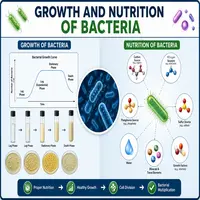
Bacterial populations grow in a predictable pattern when placed in a favorable environment. The flowchart below outlines the standard phases of bacterial growth observed in laboratory cultures.
START
  │
  ▼
Lag Phase (bacteria adapt, minimal division)
  │
  ▼
Log (Exponential) Phase (rapid, continuous division)
  │
  ▼
Stationary Phase (growth rate equals death rate)
  │
  ▼
Death (Decline) Phase (nutrients depleted, cells die off)
  │
  ▼
END
First, during the lag phase, bacteria adjust to their new environment and produce the enzymes needed for growth. Then, once adapted, the population enters the log phase, where cell division happens rapidly and predictably. Afterward, as nutrients become scarce and waste products accumulate, growth slows and enters the stationary phase.
Eventually, the death phase begins as nutrients run out completely and toxic byproducts build up faster than cells can survive. Subsequently, the population declines steadily until very few viable cells remain. This growth pattern, though simple in concept, forms the foundation for nearly every microbiology experiment involving bacterial cultures.
Clinical Importance in Pathology
Understanding growth and nutrition of bacteria has direct clinical relevance in diagnosing infections. Laboratories use nutrient-rich or selective media specifically designed to encourage the growth of suspected pathogens while suppressing others. For example, blood agar supports a wide range of bacteria, whereas MacConkey agar selectively favors gram-negative organisms.
In fact, many diagnostic tests depend entirely on knowing how a bacterium feeds and grows. Similarly, antibiotic sensitivity testing relies on placing bacteria in controlled nutritional environments to observe how they respond to different drugs. Meanwhile, hospitals use this knowledge to prevent outbreaks by understanding which conditions allow bacteria to multiply on surfaces or medical equipment.
Ultimately, this field continues to evolve alongside modern diagnostic technology. Genomic sequencing now allows researchers to predict a bacterium’s nutritional needs before it is even cultured, speeding up diagnosis significantly. Nevertheless, traditional culture-based methods remain essential, especially in resource-limited settings where advanced equipment isn’t always available.
Conclusion
The growth and nutrition of bacteria form the backbone of modern microbiology and pathology. From understanding how bacteria absorb nutrients to recognizing the phases of the growth curve, this knowledge helps professionals diagnose infections accurately and develop effective treatments. Each nutritional category and growth factor plays a distinct role in determining where and how bacteria survive.
As diagnostic technology advances, this foundational knowledge remains just as relevant as ever. Therefore, whether you’re a pathology student, a lab technician, or simply curious about microbiology, understanding how bacteria grow and feed offers valuable insight into the invisible world driving so much of human health and disease.
Frequently Asked Questions
Nutrition provides the building blocks and energy bacteria need to produce enzymes, repair cells, and divide, making it essential for survival and reproduction in any environment.
The log, or exponential, phase is the fastest, during which bacteria divide rapidly and continuously as long as nutrients and space remain available.
Yes, anaerobic bacteria survive without oxygen and can even be harmed by its presence, while facultative anaerobes can adapt to both oxygen-rich and oxygen-free environments.
Different media support or suppress specific bacterial species based on their nutritional needs, allowing pathologists to isolate and identify suspected pathogens more accurately.
Most disease-causing bacteria grow best near human body temperature, around 37°C, which is why fever and temperature control play a role in both infection and treatment.