Facial Growth and Development: A Simple Guide
Have you ever wondered why a child’s face changes so much between infancy and adulthood? The answer lies in a process called facial growth and development. This process shapes the jaw, cheekbones, and skull over many years. It also affects how teeth align and how the face looks in profile. This guide breaks the topic down into simple sections. You will find tables, a flowchart, and answers to common questions.
Why This Process Matters in Oral Biology
Dentists and orthodontists study this topic closely. Their treatment plans often depend on how a patient’s face is still growing. For instance, a growing jaw responds differently to braces than a fully grown one. Therefore, timing matters greatly in dental care.
Bones, muscles, and soft tissue all grow together. Meanwhile, genetics and environment both play a role. Nutrition, breathing habits, and even thumb-sucking can influence outcomes. Consequently, early evaluation helps catch problems before they become severe.
Stages of Growth From Birth to Adulthood
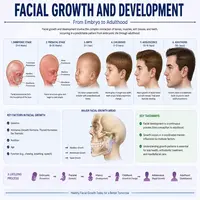
Growth does not happen at a constant rate. Instead, it moves through distinct phases. Below is a simple table showing the major stages:
| Stage | Age Range | Key Changes |
|---|---|---|
| Infancy | 0–2 years | Rapid skull growth, first teeth erupt |
| Early Childhood | 2–6 years | Jaw widens, primary teeth complete |
| Mixed Dentition | 6–12 years | Permanent teeth emerge, jaw lengthens |
| Adolescence | 12–18 years | Growth spurt, facial profile matures |
| Adulthood | 18+ years | Growth slows, minor changes continue |
As shown above, the biggest changes happen before age eighteen. However, subtle shifts can continue well into adult life.
How Bones and Muscles Work Together
Bone growth does not occur alone. Muscles attached to the jaw and face pull and shape bone tissue over time. Similarly, chewing forces influence how the jaw develops. Soft tissue, including skin and fat, also adjusts as the underlying structure changes.
This entire process depends on coordinated signals between cells. Additionally, hormones released during puberty accelerate growth in specific areas. As a result, teenagers often experience noticeable facial changes within a short period.
A Simple Flowchart of the Growth Process
Understanding the sequence helps clarify why timing matters in treatment. Here is a basic flowchart:
Genetic Blueprint Established at Birth
        ↓
Bone Growth Begins at Growth Plates
        ↓
Muscle Function Shapes Bone Structure
        ↓
Teeth Erupt and Guide Jaw Alignment
        ↓
Hormonal Changes Trigger Growth Spurts
        ↓
Growth Plates Close, Facial Shape Stabilizes
Each step builds on the one before it. Consequently, disruption at any stage can affect the final outcome.
Factors That Influence the Process
Several factors shape how a face develops over time. Genetics sets the basic pattern, yet outside influences can shift the result significantly.
- Breathing habits – mouth breathing can alter jaw shape
- Nutrition – poor diet may slow bone development
- Oral habits – thumb-sucking can affect tooth alignment
- Posture – head position influences jaw positioning
- Injury – trauma during childhood can disrupt normal patterns
Because these factors interact, professionals often recommend early dental checkups. Early intervention frequently prevents bigger issues later.
Common Problems Linked to Abnormal Growth
Sometimes this process does not follow a typical pattern. When that happens, several conditions may appear:
| Condition | Description |
|---|---|
| Malocclusion | Teeth do not align properly |
| Crossbite | Upper and lower jaws do not meet correctly |
| Open Bite | Front teeth fail to touch when biting |
| Facial Asymmetry | One side of the face grows differently |
Orthodontists often correct these issues during childhood. Meanwhile, adults may require surgery if growth has already finished.
Supporting Healthy Growth Naturally
Parents and caregivers can support healthy patterns through simple habits. Encouraging nasal breathing over mouth breathing helps jaw shape develop properly. Balanced nutrition, rich in calcium and protein, supports strong bone formation.
Regular dental visits also catch early warning signs. Furthermore, addressing oral habits like thumb-sucking early can prevent long-term complications. These small steps often make a significant difference over time.
Conclusion
This gradual, layered process is shaped by genetics, muscles, bones, and daily habits. Understanding this process helps explain why children’s faces change so dramatically over the years. It also explains why dental professionals emphasize early evaluation and timely treatment. By recognizing the stages and factors involved, parents and patients can support healthier outcomes. Simple habits, paired with regular checkups, often make the biggest difference in long-term facial health.
Frequently Asked Questions
Most major changes complete by age eighteen, though minor adjustments can continue into early adulthood.
Yes, chronic mouth breathing can alter jaw position and contribute to a narrower dental arch.
Early evaluation allows dentists to guide growth patterns before problems become harder to correct.
Genetics sets the basic pattern, but nutrition, habits, and environment also play significant roles.
Yes, adults can address issues through orthodontic treatment or surgical options, depending on severity.